Showing posts with label ram. Show all posts

Wednesday, August 20, 2014

Ram in Altered States

One of our first rams was a beautiful Barbado hair sheep ram.  There really was nothing much to fault him on, he has a great hair coat and shed fully in the spring, fantastic horns, he was not aggressive at all so we never felt afraid of him.  The only problem with him was that he was totally sterile.

We had purchased him at an auction and after keeping him for a year without getting any lambs it was pretty clear that perhaps he was past his prime.  We never did have a vet check him, we just sold him at auction with the suggestion he be used as a pet.


As he was handsome I one day did a painting of him using acrylic paints. I really liked the way his horns looked in the painting, I have painted horses and dogs before, but never painted anything with horns.  I love how the horns turned out although I am not particularly happy with the mouth, but never mind...

So today as I was a bit bored and looking through some of my older photographs I came upon a picture of the painting of this Barbado hair sheep ram and thought I might mess about with it in Corel Paint.  I am not really familiar with the program all that much, I just sort of play with it, doing this or that, seeing if I like it and if not I do something different.


I sort of like the image I created today, so wanted to share it with you.  Digital art can be very interesting.

Friday, January 10, 2014

Katahdin Hair Sheep Ram Cross

Rams, male sheep, are sexually mature at five months of age.  They are not physically mature for another six to twelve months, as some sheep breeds grow faster than others.

Katahdins are relatively slow growing sheep, the rams mature slowly in terms of their physical size and appearance.  By the time they are a year they are pretty impressive, but at the age of two they can be quite stunning.  I remember at one auction a 4 year old Katahdin ram entered the ring and people gasped as so few had seen anything like it, he looked like a miniature cow, wide nose, strong appearance, and he was brown too. 

6 month old Katadhin cross ram. 


This (photo above) is a young Katahdin cross ram, he is not purebred, his mother is a Barbado hair sheep cross.   Hair sheep have many advantages and they are becoming more and more popular in the United States and Canada, where wool is generally not as valuable as it was even 20 years ago.  The photo gives you a good idea of how hair sheep look in the winter - as he does have a thicker coat.  He is only 6 months old in this picture and will get a longer mane as he gets older.

You can see his tail is a bit shorter than the natural tail of a wool sheep breed. Hair sheep do have shorter tails, and they are less likely to become dirty with feces.


Hair sheep do not need their tails docked, do not need to be sheared, are more parasite resistant and there are claims that their meat tastes superior, even in older animals.  I personally do not eat lamb or mutton, this is just what I have heard and read.

I try not to treat the rams as "pets" as I find if they are too friendly they can also become dangerous.   I like my ewes to be tame and friendly, but if a ram is a little bit scared of me that is okay!

Tuesday, October 1, 2013

The Benefits of Breeding to a Hair Sheep Ram

Fall is typically when sheep producers look for a new breeding ram.

Unless a person is set on breeding sheep for wool (which has lost its value in some areas) or they insist on breeding purebred sheep, there is no reason why a person with wool ewes should not select to breed to a hair sheep ram, in fact there are many advantages of breeding to a hair sheep ram.

Katahdin hair sheep ram


Easier Lambing

Hair sheep tend to have slightly smaller birth weights, which makes for easier lambing and fewer complications.  The lambs are still healthy and strong and, especially with a good milk producing ewe, will grow up well.

Meat Quality

If a person is wanting to sell lambs for meat their are many advantages of selecting a hair breed ram including the fact that ethnic buyers tend to prefer to buy hair sheep because that is what they are more familiar with.  The carcass quality of hair sheep is very good and the flavor is said to be better as well.  Even older hair sheep can be easily marketed for meat.

Less Work

The lambs of hair sheep, and hair sheep crosses, do not need their tails to be docked.  They tend to be shorter and will not get as wooly.  Ethnic buyers prefer to buy lambs that did not have their tails docked.  The ram itself will not need to be sheared in the spring, instead he will shed his hair and be ready for summer.

Hybrid Vigor

By breeding to a ram of a different breed than the ewes a producer can take advantage of a genetic benefit known as hybrid vigor.   This means the lambs are usually genetically more healthy than their parents, and tend to be better sheep.

Health Benefits

Hair sheep tend to be more parasite resistant, and seldom suffer from hoof rot.

Hair sheep x lamb


Hair Sheep Breeds

There are many different hair sheep breeds some of the most common are the Katahdin, Dorper, St. Croix, and Barbado.

Each hair sheep breed is slightly different, some have more color than others, and some have horns, but all have the advantages as listed above and should be considered when selecting a new ram for breeding season.

Thursday, August 29, 2013

Fall is Ram Lamb Selling and Buying Time

I find that lambs tend to sell best in the spring.  People either want them for Easter, or other religious festivals, or they want them for pasture control.  Breeding in order to have spring lambs means lambing in the winter which is hard work but profitable.

Normally I breed my sheep for spring lambs and have them sold quite early in the summer, however this summer was crazy and I only started advertising them a few weeks ago.  I had one fellow call and say he wanted all the ram lambs.  He was busy and asked if I could hold them for him for another week. I agreed, but after 10 days passed I got a hold of him and I guess something came up and he could not make it.

Normally I get tons of calls for lambs, but normally I advertise them a lot earlier than I did this year.  I am in Canada and find that kijiji.ca is a good place to advertise livestock for sale, however they list sheep in with horses and get a lot of horses, so my sheep ad was soon bumped to page 7 and appears to be lost...

Another site I use to advertise sheep for sale is Ropin' The Web which is strictly for buying and selling livestock in Alberta.  I use to get a lot of inquires from this site, however it seems to be less popular now than a few years ago.
Above is one of my more interesting looking ram lambs.  The angle of the photo is awful, please forgive me for that as it does make him look a bit distorted, but his coloring and markings are cool... too bad I have a shadow on him too, I really must get better pictures!  He is a Jacob x Katahdin. 

I am hoping to get some inquires soon as fall is typically the time of year when people buy rams for breeding.  Sheep are pregnant for 5 months and most ewes come into season only in the fall (from early August to December) so now is the time for breeding.  Next year I will not put off advertising them for sale so late!  At least the pasture is good this year as we have had loads of rain, so their is plenty for all to eat. 

As my regular readers know I have mostly hair sheep as I find them a better sheep for the hobby farmer but they are also becoming increasingly popular for meat too.   Hair sheep tend to have a better resistance to parasites and they do not need shearing which can be a lot of work and a major expense which is not justified in areas where wool is not valuable.

Sunday, April 14, 2013

Katahdin Hair Sheep

Meet the Katahdin sheep, one of a few hair sheep breeds. They do not grow a fleece that would need shearing, and instead shed the thicker winter coat every spring.

Origins of Katahdin Sheep


Michael Piel, of Maine, USA, set about creating a breed of sheep to use for land maintenance, to control vegetation growth around power lines. In 1957 he imported three young African Hair Sheep, all of whom had been triplets but were not related to each other. Two were ewes, and one was a ram. From there he set about breeding them with each other and other select breeds including the Suffolk, Hampshire, and Cheviot.

He selected the sheep he kept for breeding based on "hair", fertility, meat type conformation, and flocking instinct. In the 1970's he named the new breed "Katahdin", after Mt. Katahdin, in Maine.

Michael passed away in 1976 and the breed went through some small changes, included an experiment in non-polled (horned) crosses, which was done away with in favor of polled (hornless) sheep.

A registry was established in 1986, under the name Katahdin Hair Sheep International.

Katahdin Ewe minutes after lambing, her back is good but the photo makes it look bad


Traits of Katahdin Sheep


The most obvious trait is that Katahdin sheep are covered with hair rather than wool, although some woolly hairs will still be present. This means they do not require shearing or their tails to be docked. The hair is somewhat coarse like that of a German Shepherd dog, and sheds in much the same way.

They are good mothers, often having triplets, although singles or twins are preferred for their first time lambing. Katahdin ewes are good milk producers, and seldom require assistance lambing (unless bred to larger breeds).

They are not a very aggressive sheep, and tend to flock moderately well.

An average Katahdin sheep ewe will weigh around 120 to 160 pounds, with the rams at 180 to 240 pounds. As such they are considered to be a "medium" size sheep.

Katahdin sheep have good parasite resistance.

The most common color being solid white, but Katahdins can also be brown or black, and occasionally are spotted.

Katahdin Ram, 1 year old


Uses of Katahdin Sheep


Katahdin sheep are terrific for hobby farmers looking for a low maintenance animal to control grass growth in their pastures. They will eat many weeds that other animals will over look.

Because they are docile and unusual looking, they also work well in petting zoos.

They are used in cross breeding programs to improve carcass condition, or for their mothering abilities.  Twins are common.

Typically though, most lambs are raised for meat. They have a top quality carcass that is mild in flavor and marketable even past the "lamb" stage. The meat is also particularly lean.

Other Information


With wool prices falling, the cost of shearing often is more than a person can market wool for, as such this breed, is gaining popularity.

Katahdin sheep are now in Canada (I have some), USA, Mexico, Chile, the UK, and Central America.

Wednesday, March 6, 2013

Four New Lambs in Two Days

Yesterday, March 5, 2013, I was home and expecting that one of our sheep would have her lambs soon.  I was on the computer helping a worried girl whose dog was showing signs of going into labor.  At one point I told her I knew what she was going through because I was waiting for a ewe to lamb.

Two Lambs

Not long after that, around my lunch time, I went out to check and sure enough there she was in the shed with two new lambs.  I went out to get her and bring her into the barn.  The weather was just around freezing and there was a breeze, no place for wet lambs to be outside.  I got them in and dried them off.

The mom is a Katahdin sheep, her sister was the ewe that gave birth only two days earlier.  I moved the sister and her lambs into a larger stall and put this new mom into the small stall.  Of course I got some new lamb pictures too!

Sadly she did have a third lamb, I found it dead in the stall later that afternoon even though I had been checking regularly.


New Lambs!

Then today, March 6, I went into the barn in the morning to find another ewe had lambed.  I was a bit surprised, we knew she was pregnant, but I still thought she had a few more days to go.  I moved the other mom into the large stall with her sister to open up the small stall for the new mother, Dark Brown Barbado, and her two lambs, one girl, one boy.

This is the ewe lamb. As you can see, she is still a bit wet, I dried them off more.


This is the sleepy ram lamb.


Well now we have just one ewe left to lamb, that being Patsy the part Jacob ewe with 4 horns.  I think she will be another few days, but she might surprise us too.  Today is a bit chilly so I do hope it warms up for all the ewes and their new baby lambs.


Join WebAnswers and get paid using Google Adsense, to ask and answer questions, as I was doing the day I found the first lambs.  Click here.

Tuesday, November 20, 2012

Disappointing Pictures of Lambs

Well I guess the title is a bit of a giveaway!

A couple of days ago the weather was good so I went to take some pictures of the sheep. There were two images I really wanted to capture, one being the difference in the coat of a wool lamb and a hair lamb, and the other was a picture of Diamond's twins (born on October 17) and Girlie's triplets (born onOctober 8) to show how much bigger Diamond's lambs are.

I was able to get one picture of a wool lamb and a hair lamb but the picture won't be winning any awards for cute lambs because I was never able to get them close together until they were walking away from me. These two are twins, their mother, Blackie sheep is part wool but has a bit of hair sheep in her too. The father is a hair sheep. You can see the lamb with more white inherited more genes for the hair coat, while the other lamb inherited genes for wool, and his coat is much shorter, and the poor guy has a harder time with the colder days.


The other planned picture of Diamond's big lambs next to Girlie's smaller lambs did not happen, the sheep were not cooperative. Diamond is a larger ewe but I think there were also other reasons why her lambs are so massive; she produces the most milk of any of our sheep, and with her lambs being twins it is normal they would be larger than triplets. I think Diamond may have been over due too. The white lamb is the ram lamb and he is bigger than the black ewe lamb.


At any rate I was a bit disappointed with my photography that day, but as the weather has turned worse (today was –12 C with a bitter wind) I will not be going out to take more pictures for a little while.

For my friends and readers in the United States I wish to wish you all a Happy Thanksgiving. If you are a pet owner I want to share with you this link to awesome BlackFriday shopping specials and deals from many companies. Some of these deals start now, and others are good until December, while a few are strictly for the Black Friday weekend and Cyber Monday (all dates are indicated).

Tuesday, October 9, 2012

It is Fall, Time to Get a Ram

Normally rams are only put with ewes for breeding and as we do not have enough space to keep rams separate from the ewes we do not keep them and instead buy one in the fall and sell him in the spring (or sooner if we have a buyer).

We had a bit of a problem this year, first we bought a truck to pull the trailer but when we went to hook it up we found that the connector for the trailer lights was different. When we got to the auction we found it had been canceled (the owner of the auction market was in hospital). 

So we phoned the guy we have gotten rams from in the past, and he said he had a nice one for us, but did warn us the ram was young, and small. We prefer rams with a bit of color or unusual markings and he did say this ram was well marked, being black and white. He is a Katahdin – Dorper cross. For those of you not familiar with these breeds, they are hair sheep, and will not grow a proper coat of wool but they do get thicker coats for winter.  

At one time we quite enjoyed having rams with horns, the horns made good handles, but we found sometimes the lambs would get their heads stuck in the fences because of the horns so now we prefer the polled rams - those without horns.

He brought the ram over in the evening and it was already dark so I called the other sheep over so he wouldn't be alone roaming the pasture and calling for friends. It was a cloudy night so the animals did not even have the moon to see each other. With my flashlight I could make out the donkey, llama, and sheep, as they greeted each other. Assured that the new ram would not go crashing through fences in the dark, I went to bed.

The next morning I was happy to see they had all bonded well. Last years ram took a few days to fit in.
Already this guy has made a pal, as he was hanging close to one of the Katahdins. Later I noticed that Mrs Dark Brown Barbado was hanging around with those two and almost in a motherly way seemed to be watching over him. I assume the Katahdin ewe is in heat and that is why he is with her.


An interesting note is that it looks like 3 of our ewes are already pregnant, we figure this must have happened back in May or June, just before we sold the ram. Sheep are pregnant for 5 months, so I expect anytime soon we will have new lambs. 

So it looks like it might be a busy winter, with some lambs born soon, and some born in March. I will keep you posted!

Wednesday, October 5, 2011

A Bright New Ram for Fall

After lambing in January and early February I had decided that this year I would plan smarter for lambs in later February or March.   As it happened there was a livestock Auction in the middle of September.  That ended up being a bit of a disaster.  We were planning on selling some chickens and ducks at the auction anyhow so got an early morning start, only to arrive at the Auction market and find out the auction was postponed until the following week. 

So once again we loaded our birds for the sale and looked forward to finding a ram for our small flock of ewes.  The problem was that not a single sheep was brought to that particular auction.  There were plenty of goats, pigs, and alpacas, but not one sheep.

We went home and looked on line at our favorite website for buying and selling livestock, but there were no rams for sale within a reasonable distance.   Panic was setting in.

Finally we found a guy, whom we had bought a ram from in the past, and as luck would have it he did have a ram for sale. 


Most people have larger farms and can keep a few rams, but with only 10 acres and no way of keeping them apart we do not keep a ram all year or we would risk him breeding ewes too soon and having lambs when we least want them!  As such we buy a ram in the fall, and sell him in the spring.

The ram we bought this year is a lovely black and white Dorper x Katahdin.  Not a purebred, but that is alright as our flock is mostly mixed ewes anyhow.  Our biggest concern was finding a ram, and we really wanted a hair sheep.

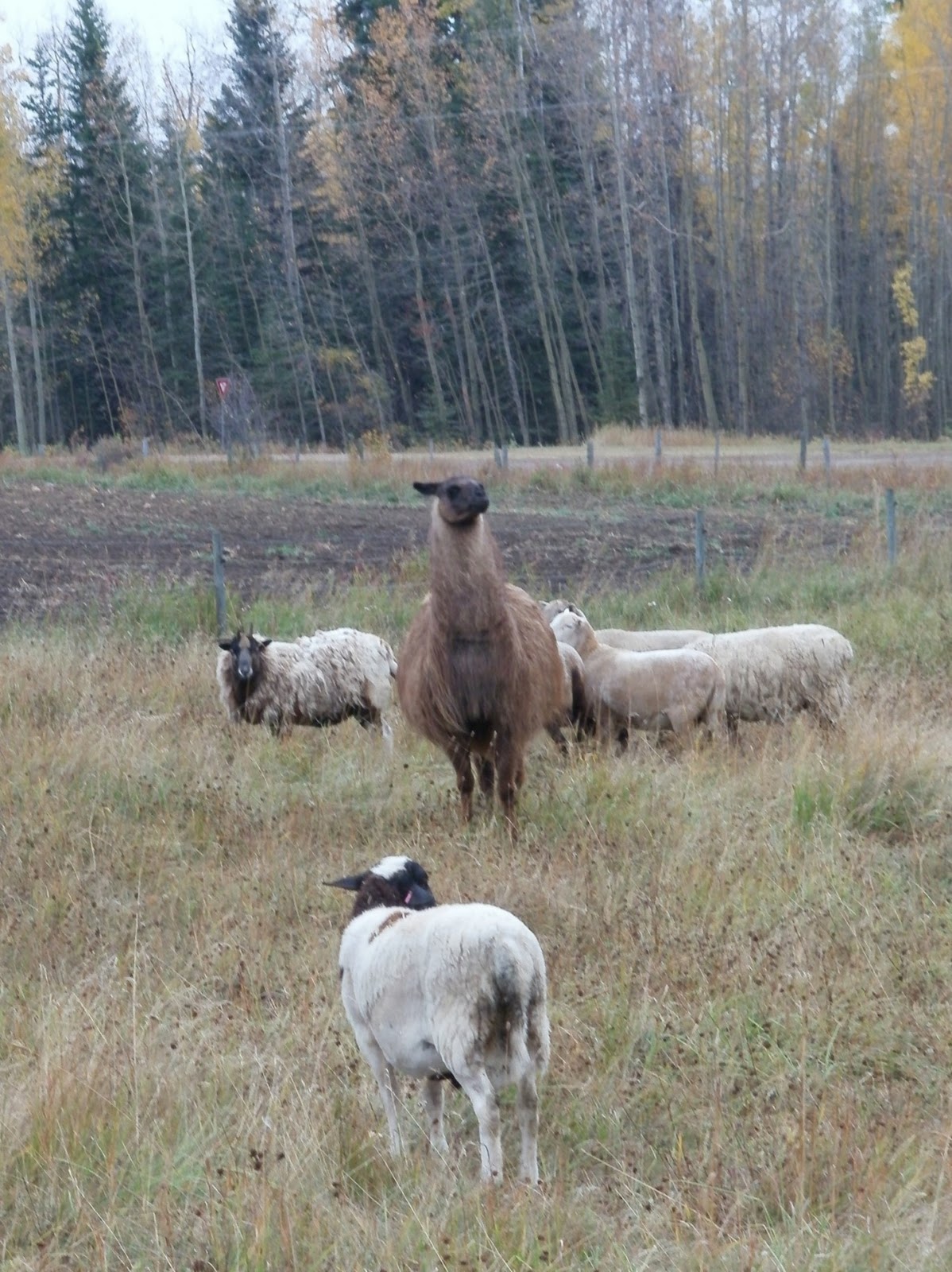
Our new ram was brought to us in the evening and it was already dark, by next day I went out to take pictures of him and watched as he tried to join the flock.  Crystal. the llama, was not about to hurt him, but I found this one picture perfect as the girls seemed to take shelter behind her.

Our new ram might just end up being called Oreo, for lack of any more original name, he is quite nice, and not as nervous around people as our last ram.  He is still young so will be big and handsome by spring when his lambs arrive.

Wednesday, September 21, 2011

The Auction that Wasn't

Every spring and fall in our area there are auctions for birds and sheep. We need a ram for the fall and want to get rid of some of the chickens and ducks as we do not have proper places to over winter those animals. I called the local auction market a month ago to find out when the sale was. I was informed it would be September 18. I need to know this because as we live in a tourist area we often work weekends and need to book time off to go to the auction.

The farm truck had not been started in over a year, that was another issue, We needed the truck to pull the trailer so we could bring home a ram. I really should not have waited until three days before the auction to try it out, but sure enough it was dead. After a lot of tinkering (and a jump start from a neighbor) we got it running, but when we turned it off it died. The price of a new battery would be more than a ram so we thought we would just go to the auction and see if anyone there could drive our new ram home.

The morning of the auction was cold, it had rained the night before and dropped below freezing for the first time this month. We got out at 8:30 in the morning to catch the birds and box them up, our hands were numb! But we got them all boxed up and the boxes just fit into our small car and off we went to the auction market.

One interesting thing did happen as we were boxing up the birds. The polish rooster screamed when he was caught and one of our cats came running, she started hissing like crazy. I don't know if she thought she was protecting us or him.


pic taken at an earlier auction


Something seemed a bit odd as we drove up, and as we got closer to the auction market it was clear. The auction had been postponed. There was a sign on the gate saying it would be next week, instead of this week. Apparently a fund raising (Terry Fox) marathon was taking place so they had to change dates. I am sure they published this in the newspaper, but we never saw anything ourselves.

I felt foolish driving home with all our birds.  The car stunk!

So... we will give it another go this Sunday, and will head to the Thorsby Auction market once again to sell our birds and buy a ram.

Monday, September 12, 2011

Selection of a Ram for Breeding Season

Fall time is when most people select the ram for their sheep production flock.  A sheep producer should be thinking about this well ahead of the time they require a ram. 

The first step in selecting a ram is to look at your ewes.  Do they have any genetic flaws that you need to avoid in your ram?  If so you need to keep this in the back of your mind when looking for your ram.  Consider what your desired lambs will look like and focus on finding a ram that will fill that gap. 

Are you breeding for meat or to produce more breeding animals?  If your goal is to produce mostly butcher lambs you need a ram that is bred for that purpose, but he does not need to be purebred, or registered.  If your goal is to produce more breeding animals, or those for show, and resale, you will want to spend more money and find a registered ram, ideally one who has proven himself at shows, or who has produced lambs who have done well.


The age of your the ram should be no younger than 5 months, by that time he will show you his potential, although he should not be put with too many ewes at this young age.  You probably will not want to buy a ram that is more than 5 years of age if you intend to keep him for many years as fertility will decline after this age.

Look at the overall condition of the ram.  Check his feet for signs of foot rot if it is known in your area.  Examine his teeth especially if you are intersted in keeping his lambs as future breeding stock.  It should also be said that a ram with small testicles should not be considered for breeding.  Ask to see his mother.  If she has lambed look at her udder;  you should not buy a ram from a ewe that has a poor udder if you want to keep ewe lambs from him for future breeding purposes.

Be sure to ask about general health of the flock and if he has been vaccinated or wormed.  Look at other sheep at the farm you are buying from, if you see any that are poorly looking, you may want to consider the overall health of the flock/farm as it relates to the prospect ram.  If the ram is thin he will need lots of extra feed to stay in top shape for breeding your ewes.

If your ewes are smaller do not over match the ram for them or they will have a difficult time giving birth and you may have several dead ewes and plenty of bottle baby lambs to look after.  Select a ram whose breed is comparable to your ewes, if they are first time lambers you may even want to select a ram that is a slightly smaller breed than the ewes. 

Thursday, April 28, 2011

Broken Horns on Sheep

When sheep break their horns it can be serious.  They could bleed to death, or they could suffer from the result of infection, or flies.  As well tetanus can be a concern. 


When we had some Jabob ewe lambs, one seemed prone to always knocking one of her horns off, causing bleeding, and worry.  If a sheep breaks a small horn treating with Iodine, or any other product you have for bleeding and/or infection, is a good idea.  You can apply something to keep the flies away too but keep it out of the wound unless instructed otherwise as per your veterinarian (not all products can be used on sheep). Make sure to stop the bleeding.

If the sheep does go off its feed, and starts grinding its teeth - call a vet.  If the horn was large and was broken right off (say on a Jacob, or Barbado ram) call a veterinarian immediately!

We just had a ram lamb, with small horn buds, knock one of the tips of his horns off.  We were separating the lambs from the ewes and accidents like this are likely to happen with lambs trying to get back to their moms. 


We treated with iodine, and are letting the wound heal on its own otherwise - exposed to the air.  It is still too cold for flies here, so we are not worried about that.

This picture was taken about 4 hours after the injury happened, it was bright red when it happened, but who thinks of taking a picture then?  You can see how small the other horn is, only about 2 inches (5cm).  The injured horn may be sore for a few days, but this little ram lamb should be fine and will continue to grow a horn in spite of the setback.

Friday, March 11, 2011

Girlies Matched Set of Twins

Girlie is part hair part wool sheep. Her mother is Mrs Dark Brown Barbado, the sheep who earlier had triplets, her father being a wool sheep x Barbado. Girlie had two lambs last year (her first lambs) but was a bit overwhelmed and we ended up bottle feeding one.

On March 10, Girlie did not come into the barn with the rest of the sheep. It was just lucky we noticed her missing really, as it was a cold night and we were hurrying. I went out and they Girlie was in the old barn, standing with two identical twins... well not quite identical, one is a ewe lamb, the other a ram lamb.

Both lambs are solid orange - their father being a Katahdin.  The little lambs needed to have their ears rubbed as they were quite cold – temperatures are still below freezing – well below seasonal normals.  The ram lamb is on the left, the ewe lamb on the right.


I took a few pictures after getting the mother ewe and her lambs set up in a stall but the camera seemed to be acting weird so gave my husband instructions to take more pictures in the morning after I went to work.

By morning time it would appear the camera was acting even weirder. My husband got several pictures, but most had terrible double images. Well that's what you get for buying a cheap Walmart Camera I guess.  The above photo is the only picture (of about 10) that did not have a double image, but the color is slightly odd.  I am pretty sure this is the ewe lamb. 

So far it looks like Girlie is letting both lambs nurse - so that is a good sign.  I hardly feel like looking after any more bottle baby sheep!

Sunday, January 16, 2011

Diamond Finally has her Lambs

If you recall, Diamond was one of the ewes that has been big for a long time, she had a huge udder, and was waddling for a while.  I kept her in the barn for the past two days.. just in case.


Well, finally, on January 16, 2011, Diamond sheep had twins!  Usually she has triplets, and was certainly big enough I was expecting triplets, however I think she was just trying to hold off for warmer weather.  It has been colder than -20c for the past 10 days at least. 


Diamonds twins are as big as the 2 week old lambs born to Blackie sheep earlier, one is a ewe lamb (a girl), the other a little ram lamb (a boy).  Yes, that is me in the back.
An odd picture perhaps.  She has just had her lambs, so the blood is normal, her udder is huge, much larger than any of our other ewes get.  Diamond is a very good mother, and produces so much milk that her lambs will grow fast, and eventually other lambs will steal milk from her when she is eating (this is common with sheep when the lambs are a bit older and bold enough to leave their own moms).

You may note, she still has snow on her back even though she has not been outside for two days.  This shows how well the wool insulates the sheep, and visa versa, her own body heat is not even melting the snow.

You will also note that Diamond's tail has been docked, her lambs show a normal sheep's tail. 

Read about Milking Sheep here.
Read about Tail Docking here.

Sunday, December 26, 2010

Sheep Horns

Depending on how familiar you are with sheep, you may have noticed that some sheep have horns and some do not. Horns on sheep are something that some keepers prefer, while others dislike.

Myself I prefer having horns on a ram, as they make for great handles, but like ewes without. That is to say I like a non-polled (has horns) ram, and polled (no horns) ewes. I do, however, have one ewe that has 5 horns, 3 well formed, and 2 smaller (scurred).


Patsy, one of our sheep, part Jacob, part Barbado.

People who breed purebred sheep might select for, or against, horns as a result of the breed standard and their own preference.   Some sheep breeds do not have horns on rams or ewes, others have horns on both genders, while others have horns only on the rams.  Owners of sheep breeds that can be either polled, or non polled, often select one or the other, but those keepers who have a preference need to select a breed that fits with their desires to have horns or not.

Goats often have their horn buds removed early in life because their horns tend to grow straight up, while sheep horns are often curled, and as such are less dangerous.  This is true of most sheep breeds, but not all, the Jacob sheep often have several horns (four is common) and these can be curled or straight.
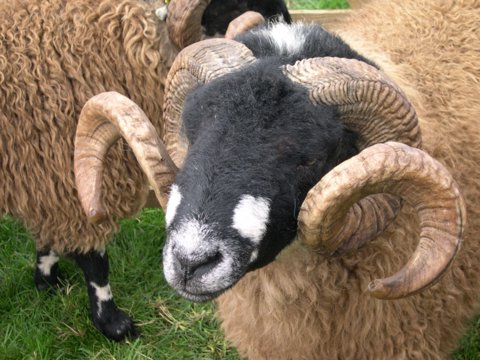
Unknown sheep breed - photo by NicePics from London, UK (Sheep with interesting horns) [CC-BY-SA-2.0 (www.creativecommons.org/licenses/by-sa/2.0)], via Wikimedia Commons

You can read more about sheep horns, advantages, disadvantages, what they are made of, and horn genetics, click here.

You can read more, and see other pictures, of the Jacob Sheep, click here.

Saturday, November 13, 2010

Painting Sheep

This is about a sheep whose picture I painted, not to be confused with Painted Sheep, a breed of sheep.

Remember that Ram I told you about earlier?... Click Here if you missed it... Well we did have some good pictures of him, and I am a painter - well at least I paint, not so much a "famous artist" or anything of the sort.

I loved the texture of his horns, and his hair, this is in the fall and he has grown a thick main, the angle is so strange it was perfect to paint.  I did the painting in acrylic paints, they dry faster than oils and have no smell.

This is a detail (part of) of the finish painting - of course you can see the background is changed to make it more dramatic from the rather boring pasture.  I also opened his eye somewhat.  I am rather happy with how his horns turned out and the hair as well - remember this is a hair sheep, a Barbado, which is not a woolly sheep - many mistake them for goats.  I really should take a better picture though.

I own the copyright for both images, they are not for reproduction.

Monday, November 1, 2010

Popular Breeds of Sheep in the USA

Worldwide there are hundreds of different breeds of sheep (and most are not white and woolly).  Certain sheep breeds are more common in certain areas of the world, according to climate, use and the whims of the people of those areas. 

Some breeds of sheep are more known for wool, although in some areas the wool market is not as strong and hair sheep (used for meat) are favored.  Most of the best wool now comes from Australia and New Zealand, where the Merino breed is popular. 

In North America other sheep breeds are more common, and the popularlity of each is always changing. 

Some sheep breeds are being favored as better for mothers (easy lambers, good milkers), others for meat, wool, and so forth.  Many sheep producers have mix breeds, keeping one breed of of sheep for ewes and another breed for their ram. 

Mixed flock of sheep, some hair sheep (Barbado), some wool sheep (Suffolk x Dorset).

Click Here to learn more about the eight most popular sheep breeds in the United States, including the Suffolk, Dorset, and Hampshire.

Monday, October 25, 2010

The First Ram

We learned more about sheep so by fall felt we were ready to get a ram for breeding.  We had learned all about the advantages of hair sheep and as there were many sheep being sold at an Odd and Unsual Livestock sale about 2 hours away, we felt this would be a good place to find a breeding ram.

They were being sold as Barbado sheep, of course this name seems to be under debate, but that is what they were called at the time, being brown and black hair sheep, with horns. 

We found a handsome ram, and bid on him, and loaded him up with a few other ewes we purchased including some bred ones.
He was a very friendly ram, which was good because it set us up to admire this breed, when many others in our area told us that all hair sheep are "wild" in nature. 

However... we waited all winter... looking forward to cute spring lambs.. and got none.. (well not from him anyhow).

Turns out the ram was sterile.  So much for that year!

Read More about Barbado Hair Sheep, click here.