Showing posts with label breeds. Show all posts

Sunday, April 14, 2013

Katahdin Hair Sheep

Meet the Katahdin sheep, one of a few hair sheep breeds. They do not grow a fleece that would need shearing, and instead shed the thicker winter coat every spring.

Origins of Katahdin Sheep


Michael Piel, of Maine, USA, set about creating a breed of sheep to use for land maintenance, to control vegetation growth around power lines. In 1957 he imported three young African Hair Sheep, all of whom had been triplets but were not related to each other. Two were ewes, and one was a ram. From there he set about breeding them with each other and other select breeds including the Suffolk, Hampshire, and Cheviot.

He selected the sheep he kept for breeding based on "hair", fertility, meat type conformation, and flocking instinct. In the 1970's he named the new breed "Katahdin", after Mt. Katahdin, in Maine.

Michael passed away in 1976 and the breed went through some small changes, included an experiment in non-polled (horned) crosses, which was done away with in favor of polled (hornless) sheep.

A registry was established in 1986, under the name Katahdin Hair Sheep International.

Katahdin Ewe minutes after lambing, her back is good but the photo makes it look bad


Traits of Katahdin Sheep


The most obvious trait is that Katahdin sheep are covered with hair rather than wool, although some woolly hairs will still be present. This means they do not require shearing or their tails to be docked. The hair is somewhat coarse like that of a German Shepherd dog, and sheds in much the same way.

They are good mothers, often having triplets, although singles or twins are preferred for their first time lambing. Katahdin ewes are good milk producers, and seldom require assistance lambing (unless bred to larger breeds).

They are not a very aggressive sheep, and tend to flock moderately well.

An average Katahdin sheep ewe will weigh around 120 to 160 pounds, with the rams at 180 to 240 pounds. As such they are considered to be a "medium" size sheep.

Katahdin sheep have good parasite resistance.

The most common color being solid white, but Katahdins can also be brown or black, and occasionally are spotted.

Katahdin Ram, 1 year old


Uses of Katahdin Sheep


Katahdin sheep are terrific for hobby farmers looking for a low maintenance animal to control grass growth in their pastures. They will eat many weeds that other animals will over look.

Because they are docile and unusual looking, they also work well in petting zoos.

They are used in cross breeding programs to improve carcass condition, or for their mothering abilities.  Twins are common.

Typically though, most lambs are raised for meat. They have a top quality carcass that is mild in flavor and marketable even past the "lamb" stage. The meat is also particularly lean.

Other Information


With wool prices falling, the cost of shearing often is more than a person can market wool for, as such this breed, is gaining popularity.

Katahdin sheep are now in Canada (I have some), USA, Mexico, Chile, the UK, and Central America.

Wednesday, December 12, 2012

What Dog Breeds are Best for Herding?

There are many dog breeds used for herding sheep, goats, cattle, and other livestock. Typically these dogs are very intelligent and do not always make ideal house pets because of their love of “work”.
Certain breeds of dogs used for herding are more popular in some areas than in others.

Border Collie


Border collies are one of the most popular herding dogs. They are highly intelligent and have a real desire to please. Movie fans will recognize this breed from the film “Babe” (the talking pig). 

They are sleek dogs with medium length hair. The most popular color for a border collie is black with white, however they can also be tri-colored or brown and white. They stand about knee high. Border collies always have an alert look in their eye, as though they are always looking for cues. If not used for herding, they enjoy agility.

Australian Cattle Dog


Also known as red heelers or blue heelers (according to their color), these dogs are tough and robust. Nipping at the heels of livestock is very much discouraged in other breeds of herding dog (such as the border collie), but the Australian Cattle dog was originally bred to nip at the heels of livestock as part of its herding behavior. Although this is not as common as it was, some dogs will still nip at running kids, or other pets.
These dogs did originate in Australia and were the product of herding dogs crossed with a few dingoes.


Welsh Corgi

photo from wikimedia commons


Welsh corgies are sometimes referred to as “The Queen's Dog” because of Queen Elizabeth's love of Pembroke Welsh corgis. The other type of Welsh corgi is the Cardigan Welsh corgi. The difference between the two is mainly that the Pembroke does not have a tail and is slightly smaller. Welsh corgis were bred to be short so they can avoid getting kicked by an angry cow or steer.

German Shepherd

©B Nelson - German Shepherd dog


Once a popular herding dog the German Shepherd is now more often used as a police, or personal protection dog. In fact most people no longer associate them with being herding dogs despite it being part of their name. 


Of course there are other collie breeds, the Shetland sheep dog, and many other dog breeds which are also popular for herding. Herding breeds should all be considered fairly intelligent and good for people who have lots of time to keep their dog mentally stimulated if not using it for herding.


Friday, November 30, 2012

Breeds of Sheep whose Wool is Used for Carpets

When we look at the kind of wool sheep have there are 4 main types, of course this is not counting the hair sheep.

Of the wool sheep there are those such as the Merino and Rambouillete who produce fine wool; wool with a diameter under 30 microns. There are long wool sheep such as the Lincoln and Romney. There are the medium wool sheep, who are also meat, such as the Dorset, Suffolk, Texel, and Hampshire, and then there are the carpet wool sheep such as the Scottish Blackface, Navajo Churro, Icelandic, Elliotdale, Carpetmaster, Drysdale, Awassi, and Karakul. Certain breeds of sheep are more popular in certain areas.


The carpet wool sheep tend to have wool that has a diameter greater than 38 microns. The wool is considered too coarse for clothing but is perfect for carpets. The sheep that produce this coarse wool often have thicker double coats, and live in cold climates.

Some people may wonder if collecting wool from a sheep for the purpose of making a carpet is cruel, but it is not as cruel as you might think. Wool is sheared from a sheep not only so we can collect it but also so the sheep do not overheat in the summer. A heavy coat of wool on an animal in the summer can cause heat stroke. Removing the wool also helps the farmer identify any problems with external parasites (keds). 

Occasionally a sheep may be nicked in the process of shearing but a good shearer is fast and does not cause undue stress, or injury, to the animals. 

In contrast a “sheepskin rug” is when the sheep is actually killed and skinned for its pelt.

The fleece that is sheared from a sheep is washed and can be dyed 

If you are looking for a carpet be sure to check Carpetvista, with over 15,000 carpets, and roughly 2,000 added each month you are sure to find the right carpet for you. Their prices are great and they have a 30 day money back guarantee. 

Carpetvista is located in Sweden but they sell affordable quality carpets throughout Europe – prices are indicated in Euros.

Handmade carpets probably originated in central Asia and are now best sold under the name of the area in which the carpet was made or by which group of people made the carpet (example a Persian rug).

Monday, April 30, 2012

Links and Information on Chickens

Over the past few years we have really enjoyed keeping chickens, at first we kept onlying laying hens for eggs.  At one time we bought 5 week old silke chicks and raised them, it turned out that three of the five were roosters, and as we had no plans on eating them, we sold them.

Last year we kept hens and roosters, with one pair hatching out nine cute chicks.  Sadly a fox killed the other hen so that rooster was left alone.

Keeping chickens as pets has been rather fun, and except for when we had the roosters with the hens we have enjoyed their eggs too.  I totally encourage others to keep chickens as backyard pets and wish more cities allowed people to do so - I am lucky to live in the country so there are no regulations in this regard.

I have encountered many interesting questions about keeping and raising chickens had have provided some links here in case anyone is wondering the same thing.

Why Won't My Chicken Eggs Hatch? - This article addresses common reasons why eggs do not hatch.

How are Chicken Eggs Formed?  - Interesting, weird and maybe not good to read before breakfast.

Abnormalities in Chicken Eggs - The eggs you get at stores are often perfect but not all eggs are so perfect. 

When will my Hens Start Laying?  - Usually hens start laying eggs at five months of age, but not always.

Below are some articles specifically related to chicken breeds.  Selecting the right breed is very important, some chickens are friendly and make great pets, others are suited for laying, meat, or are dual purpose.

About Orpington Chickens - A popular dual purpose chicken breed

Araucana and Ameraucan Chickens - The ones that lay blue or green eggs.

Bantam Chickens - Small chickens well suited to being kept as pets.

Silkie Chickens - Fluffy and cute ones common as pets.

Of course there are more breeds than those listed, but these are the ones I am most familiar with and have articles on at this point.  You might also want to read an article on General Chicken Trivia.

Overall I have found keeping chickens to be great, they are not as stupid as people often make them out to be, and they enjoy being out free range in the yard.  Chickens will eat slugs, grasshoppers, and other insect pests too - even ticks.   They do need to be confined in a coop at night for their own safety.  Sometimes they may want to roost in a tree but they may be vulnerable from predators (mink, raccoons, and so forth).

Thursday, April 19, 2012

Tips on Keeping Goats or Sheep


Many hobby farmers, or acreage owners, have found that sheep or goats are great for pasture control. These small animals are much easier to handle than cattle, and require less space. They can be kept as pets, raised for meat, or as companions when only one horse is owned. There are a few differences between sheep and goats, the most concerning being diet (sheep cannot have copper but goats need it). With many breeds of each there is most certainly something for everyone.


If you are interested in keeping sheep or goats, this article is to provide basic information as well as to suggest other articles for further reading.

Sheep and Goat Diseases


You should speak to your veterinarian in regards to what sheep, or goat, diseases are common in your areas. Two of the most concerning are scrapie, and footrot. As well there are concerns about parasites so you will want to worm them yearly.  If you plan on breeding sheep or goats you will also want to be aware of mastitis, or an infection of the udder.

Breeds of Sheep and Goats


There are hundreds of different sheep and goat breeds, some suited more for dairy, others for meat, and others for fiber. Two of the most popular goats for fiber are the Cashmere goats and a Angora goats.


For sheep there are many hair sheep breeds which are less maintenance for people who do not want to worry about shearing. There are also some novelty sheep such as the Jacob sheep (often having 4 horns) and the rarer breeds such as the Icelandic Sheep.


With the wool sheep shearing is a concern as they can over heat if left with their wool on. Tail docking is usually often done in wool sheep.

Katahdin hair sheep ewe and lambs

Breeding


If you are interested in breeding sheep or goats, both have a similar 5 month gestation so the billy, or ram, is put with the flock usually in the fall for spring kids, or lambs.


You need to be prepared to bottle feed kids or bottle feed lambs as sometime doe or ewe is unable to do so for all her offspring.

Fencing


Fencing is also a concern in that goats can climb (or sneak under) many types of fence.  Proper fencing is needed as well to keep predators out.  A 3-strand barbed wire fence will not contain sheep or goats.

Guard Animals


In areas where coyotes, or other predators (even stray dogs) are a concern, many people keep a guard animal with their sheep or goats.  There are many dog breeds for this purpose as well as a donkey or llama. 

Sunday, December 26, 2010

Sheep Horns

Depending on how familiar you are with sheep, you may have noticed that some sheep have horns and some do not. Horns on sheep are something that some keepers prefer, while others dislike.

Myself I prefer having horns on a ram, as they make for great handles, but like ewes without. That is to say I like a non-polled (has horns) ram, and polled (no horns) ewes. I do, however, have one ewe that has 5 horns, 3 well formed, and 2 smaller (scurred).


Patsy, one of our sheep, part Jacob, part Barbado.

People who breed purebred sheep might select for, or against, horns as a result of the breed standard and their own preference.   Some sheep breeds do not have horns on rams or ewes, others have horns on both genders, while others have horns only on the rams.  Owners of sheep breeds that can be either polled, or non polled, often select one or the other, but those keepers who have a preference need to select a breed that fits with their desires to have horns or not.

Goats often have their horn buds removed early in life because their horns tend to grow straight up, while sheep horns are often curled, and as such are less dangerous.  This is true of most sheep breeds, but not all, the Jacob sheep often have several horns (four is common) and these can be curled or straight.
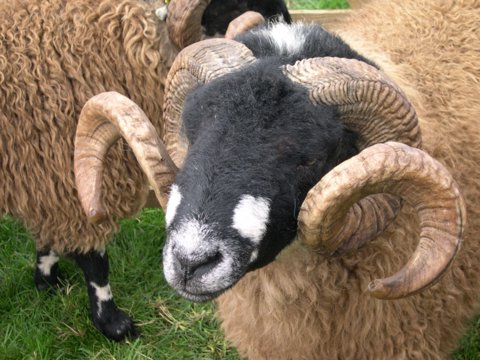
Unknown sheep breed - photo by NicePics from London, UK (Sheep with interesting horns) [CC-BY-SA-2.0 (www.creativecommons.org/licenses/by-sa/2.0)], via Wikimedia Commons

You can read more about sheep horns, advantages, disadvantages, what they are made of, and horn genetics, click here.

You can read more, and see other pictures, of the Jacob Sheep, click here.

Monday, November 1, 2010

Popular Breeds of Sheep in the USA

Worldwide there are hundreds of different breeds of sheep (and most are not white and woolly).  Certain sheep breeds are more common in certain areas of the world, according to climate, use and the whims of the people of those areas. 

Some breeds of sheep are more known for wool, although in some areas the wool market is not as strong and hair sheep (used for meat) are favored.  Most of the best wool now comes from Australia and New Zealand, where the Merino breed is popular. 

In North America other sheep breeds are more common, and the popularlity of each is always changing. 

Some sheep breeds are being favored as better for mothers (easy lambers, good milkers), others for meat, wool, and so forth.  Many sheep producers have mix breeds, keeping one breed of of sheep for ewes and another breed for their ram. 

Mixed flock of sheep, some hair sheep (Barbado), some wool sheep (Suffolk x Dorset).

Click Here to learn more about the eight most popular sheep breeds in the United States, including the Suffolk, Dorset, and Hampshire.