Showing posts with label advantages. Show all posts

Sunday, December 26, 2010

Sheep Horns

Depending on how familiar you are with sheep, you may have noticed that some sheep have horns and some do not. Horns on sheep are something that some keepers prefer, while others dislike.

Myself I prefer having horns on a ram, as they make for great handles, but like ewes without. That is to say I like a non-polled (has horns) ram, and polled (no horns) ewes. I do, however, have one ewe that has 5 horns, 3 well formed, and 2 smaller (scurred).


Patsy, one of our sheep, part Jacob, part Barbado.

People who breed purebred sheep might select for, or against, horns as a result of the breed standard and their own preference.   Some sheep breeds do not have horns on rams or ewes, others have horns on both genders, while others have horns only on the rams.  Owners of sheep breeds that can be either polled, or non polled, often select one or the other, but those keepers who have a preference need to select a breed that fits with their desires to have horns or not.

Goats often have their horn buds removed early in life because their horns tend to grow straight up, while sheep horns are often curled, and as such are less dangerous.  This is true of most sheep breeds, but not all, the Jacob sheep often have several horns (four is common) and these can be curled or straight.
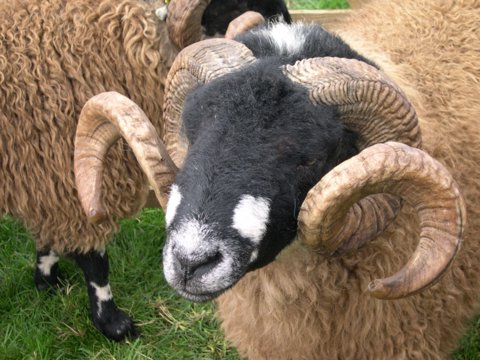
Unknown sheep breed - photo by NicePics from London, UK (Sheep with interesting horns) [CC-BY-SA-2.0 (www.creativecommons.org/licenses/by-sa/2.0)], via Wikimedia Commons

You can read more about sheep horns, advantages, disadvantages, what they are made of, and horn genetics, click here.

You can read more, and see other pictures, of the Jacob Sheep, click here.

Monday, December 6, 2010

Advantages of Hair Sheep

Our first sheep were hair sheep but eventually we decided that hair sheep are the way to go.  They get thicker winter coats, and even have some wool hairs in the winter, but they shed in the spring and summer.  This means less work, which is great, particularly in areas where wool is not worth shearing and selling.  I note here that even if wool has no monetary value the wool sheep should still be shorn or they suffer in the heat. 

Hair sheep do not need their tails docked because they are shorter and as their tails are not covered in wool, the feces do not stick to them.  Typically wool sheep have their tails docked because manure stuck in the tail attract flies.

Katahdin ram
Hair sheep breeds tend to be smaller than most of the popular wool breeds, which makes them better to work with on small farms, or for people who are not strong enough for larger animals.  Although some people consider some of the hair breeds to be more nervous I have not found this to be the case. 

There are also many claims that hair sheep experience fewer problems with internal parasites.  I will say that keds are much less of a problem with hair sheep.

We find having a hair sheep ram to be the best for our breeding program, which includes larger wool sheep ewes as well as some hair sheep ewes.   The hair sheep ram means smaller lambs at birth, which translates to fewer lambing problems for the ewe.  I would not suggest breeding a hair sheep ewe to a larger wool breed ram.  The hair x wool sheep have an odd sort of coat that sheds partially.


We live in Canada, and have cold weather in the winters.  They hair sheep grow thicker coats in the winter, but should have winter protection (we keep ours in an unheated barn at night in the winter).  This is not so much of an issue really as we lamb in the winter so all our ewes are in the barn at night regardless of breed.  As you would expect, they are very tolerant of hot weather.

I would especially encourage anyone who wants to have sheep as pets, for meat, or for pasture control to consider hair sheep.

We have owned Barbado hair sheep as pictured above, Dorper, and Katahdin, which I am sure you will read about it other blog posts here!