I find that lambs tend to sell best in the spring. People either want them for Easter, or other religious festivals, or they want them for pasture control. Breeding in order to have spring lambs means lambing in the winter which is hard work but profitable.
Normally I breed my sheep for spring lambs and have them sold quite early in the summer, however this summer was crazy and I only started advertising them a few weeks ago. I had one fellow call and say he wanted all the ram lambs. He was busy and asked if I could hold them for him for another week. I agreed, but after 10 days passed I got a hold of him and I guess something came up and he could not make it.
Normally I get tons of calls for lambs, but normally I advertise them a lot earlier than I did this year. I am in Canada and find that kijiji.ca is a good place to advertise livestock for sale, however they list sheep in with horses and get a lot of horses, so my sheep ad was soon bumped to page 7 and appears to be lost...
Another site I use to advertise sheep for sale is Ropin' The Web which is strictly for buying and selling livestock in Alberta. I use to get a lot of inquires from this site, however it seems to be less popular now than a few years ago.
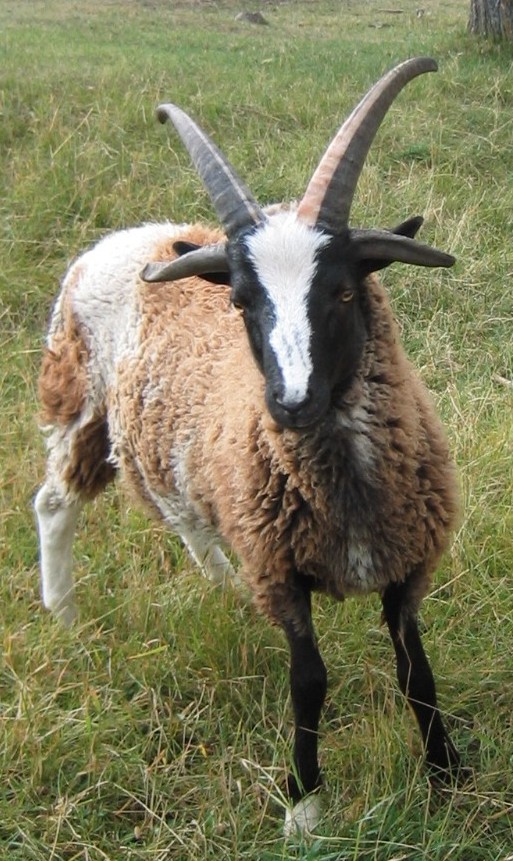
Above is one of my more interesting looking ram lambs. The angle of the photo is awful, please forgive me for that as it does make him look a bit distorted, but his coloring and markings are cool... too bad I have a shadow on him too, I really must get better pictures! He is a Jacob x Katahdin.
I am hoping to get some inquires soon as fall is typically the time of year when people buy rams for breeding. Sheep are pregnant for 5 months and most ewes come into season only in the fall (from early August to December) so now is the time for breeding. Next year I will not put off advertising them for sale so late! At least the pasture is good this year as we have had loads of rain, so their is plenty for all to eat.
As my regular readers know I have mostly hair sheep as I find them a better sheep for the hobby farmer but they are also becoming increasingly popular for meat too. Hair sheep tend to have a better resistance to parasites and they do not need shearing which can be a lot of work and a major expense which is not justified in areas where wool is not valuable.
Learn about sheep and their care. Follow our Sheep Experience, as we share pictures and information about our pet sheep, and sheep in general.
Showing posts with label ewes. Show all posts
Thursday, August 29, 2013
Wednesday, March 7, 2012
Okay, Everyone Go Play in the Snow
Over the weekend we had a lot of snow, more snow I think than we had all winter.
Today the temperatures were expected to be above freezing, and it was not windy so I thought this would be a great day to get some of the new lambs outside.
I put Blackie, her two lambs, Dark Brown Katahdin, and her twins, as well as Patsy sheep and her twins, outside in the morning at feeding time. This would have been a good time for pictures as Crystal the llama especially loves seeing the new lambs. Aggie the donkey likes them okay too, but Crystal really adores them. However as I was very busy getting everyone sorted out I did not plan for photos.
Here they are later in the day.
I kept Girlie and her triplets in the barn. Although they are a week old now they are much smaller than the other lambs and the one needs bottle feeding. It is pretty hard for the sheep to keep track of two lambs when outside, and three is much harder. Because the temperatures were not great, it is simply better not to risk putting them out. Besides, they were able to keep Diamond and her two-day-old triplets company, as they are also still in the barn.
Two of Diamond's triplets have fetlocks that are still a bit bent, a likely result of being cramped before birth, so, although they can walk, they need to let their legs stretch out before they would be able to keep up outside in the snow. I am trying to spend a few minutes every day with the lambs stretching out their joints a bit to make them stronger. This problem does occur from time to time although I have not had a lamb with it prior, and it ususally corrects itself in a few days to a week.
Anyhow the moms and lambs that were out in the snow were probably glad to get out of the barn, and I have been checking to make sure they are doing well. The show is about 20 cm (8 inches) deep in most places but deeper in areas where it has drifted.
The sheep walk on the same path and actually pack it down so well that when the other snow melts the path of packed snow often remains as ice and is the last to go.
Not a great day for photos, I took more picutres of them in the shed but they all turned out too dark to show off.
Today the temperatures were expected to be above freezing, and it was not windy so I thought this would be a great day to get some of the new lambs outside.
I put Blackie, her two lambs, Dark Brown Katahdin, and her twins, as well as Patsy sheep and her twins, outside in the morning at feeding time. This would have been a good time for pictures as Crystal the llama especially loves seeing the new lambs. Aggie the donkey likes them okay too, but Crystal really adores them. However as I was very busy getting everyone sorted out I did not plan for photos.
Here they are later in the day.
Two of Diamond's triplets have fetlocks that are still a bit bent, a likely result of being cramped before birth, so, although they can walk, they need to let their legs stretch out before they would be able to keep up outside in the snow. I am trying to spend a few minutes every day with the lambs stretching out their joints a bit to make them stronger. This problem does occur from time to time although I have not had a lamb with it prior, and it ususally corrects itself in a few days to a week.
Anyhow the moms and lambs that were out in the snow were probably glad to get out of the barn, and I have been checking to make sure they are doing well. The show is about 20 cm (8 inches) deep in most places but deeper in areas where it has drifted.
The sheep walk on the same path and actually pack it down so well that when the other snow melts the path of packed snow often remains as ice and is the last to go.
Not a great day for photos, I took more picutres of them in the shed but they all turned out too dark to show off.
Wednesday, February 15, 2012
Lambing Time Almost Here
Today is February 15, 2012, in a little over 2 weeks our ewes are due to have their lambs. This year we wanted to make sure the lambs were not born in January so we got a ram a little later than we had in the past, putting him with the ewes on October 4. In previous years lambing in the middle of winter was hard work combined with the extra feed needed and risk to lambs being born in the cold. Ironically this winter has been the mildest ever, we hardly have any snow, and temperatures have been pretty good for central Alberta!
With the sun shining and the girls all having big tummies I thought it would be a good day to take some pictures, so that is exactly what we did. Actually my goal was to get a picture of the ram trying to charge me, he has been the first ram we have had that even tries this. He only does it if I am not looking but on this day he didn't seem interested. Normally I have to be very aware of where he is and if I feel he is planning a sneak attack, and turn, he pretends he was not up to anything at all. Quite funny really, also he is small so not really a danger.
Anyhow for a while I had been worried that the ewes were not getting big, if you recall the first year we had sheep the ram we bought was infertile - I don't want to go through that again! But in the last couple of weeks the ewes started getting bigger and there udders were showing.
Most of the ewes are getting udders, a few are bigger than others. Diamond sheep is the largest, she usually has triplets, only once did she have twins. Blackie, and Girlie are pretty big too. In this picture you can see Diamonds rear end, and her swollen tummy. You may also note how there is no snow, last year at this time it was up to above there stomachs, I had to shovel paths for them in some areas; this year, next to nothing.
We only have 9 ewes, that seems like a more manageable number for our small hobby farm (we are not big time sheep breeders). It is hard to get sheep to pose for their picture, but I think my husband did a good job getting some of them looking in the right direction for this shot.
Here is another picture, this time you can see Diamond sheep facing amost head on, with Mrs Brown Katahdin to the left and the ram to the right (our right, not Diamond's).
Aggie the donkey is in behind.
With the sun shining and the girls all having big tummies I thought it would be a good day to take some pictures, so that is exactly what we did. Actually my goal was to get a picture of the ram trying to charge me, he has been the first ram we have had that even tries this. He only does it if I am not looking but on this day he didn't seem interested. Normally I have to be very aware of where he is and if I feel he is planning a sneak attack, and turn, he pretends he was not up to anything at all. Quite funny really, also he is small so not really a danger.
Most of the ewes are getting udders, a few are bigger than others. Diamond sheep is the largest, she usually has triplets, only once did she have twins. Blackie, and Girlie are pretty big too. In this picture you can see Diamonds rear end, and her swollen tummy. You may also note how there is no snow, last year at this time it was up to above there stomachs, I had to shovel paths for them in some areas; this year, next to nothing.
We only have 9 ewes, that seems like a more manageable number for our small hobby farm (we are not big time sheep breeders). It is hard to get sheep to pose for their picture, but I think my husband did a good job getting some of them looking in the right direction for this shot.
Here is another picture, this time you can see Diamond sheep facing amost head on, with Mrs Brown Katahdin to the left and the ram to the right (our right, not Diamond's).
Aggie the donkey is in behind.
Tuesday, November 8, 2011
Snowy Morning and Bad Llama
A couple of days ago we woke up to snow, the first so far. Normally, here in Alberta, we would have had more by now, but the fall has been wonderful. Even the bit that we did get was not enough to shovel.
The animals can still get grass but in the fall there is very little nutrition in the grass so we feed hay, just once a day for now, they will get fed twice a day later when we really start getting snow, and winter sets in.
We do have proper feeders near the barn for feeding hay, but have 2 bales near the house which we are feeding now. One of the round bales was just a bit too close to the fence and Crystal decided to help herself. As a result she has bent the fence. I nailed a board across the top, but she leaned on it so bad it broke off. Eventually the bale will be out of reach, but it's funny because even when there is plenty in the pasture she insists on eating from the bale. I think it is because she has it all to herself that way.
I always try to throw out several piles of hay because the animals tend to move around from pile to pile and push others away, by having extra piles it means everyone gets something to eat.
As we only have 10 acres we do not grow our own hay, rather we buy it and have it delivered. We do not even have a tractor to move bales around, so must feed by hand. Certainly small square bales are easier to feed, but they cost more money, and are getting harder to find. As such we buy the large round bales and have them delivered.
We put tarps over the bales to protect them, sun can take away nutrition from hay, and if water gets into the bales they will rot!
When we buy the hay it is always hardest to know how much to buy. In the past we have not bought enough and had to get some in the spring. This was often because it kept snowing, and snowing, and snowing, so we kept feeding, and feeding, and feeding. Hopefully this spring we will not have to worry about that and I will not need any more hay.
The animals can still get grass but in the fall there is very little nutrition in the grass so we feed hay, just once a day for now, they will get fed twice a day later when we really start getting snow, and winter sets in.
| Naughty llama |
We do have proper feeders near the barn for feeding hay, but have 2 bales near the house which we are feeding now. One of the round bales was just a bit too close to the fence and Crystal decided to help herself. As a result she has bent the fence. I nailed a board across the top, but she leaned on it so bad it broke off. Eventually the bale will be out of reach, but it's funny because even when there is plenty in the pasture she insists on eating from the bale. I think it is because she has it all to herself that way.
I always try to throw out several piles of hay because the animals tend to move around from pile to pile and push others away, by having extra piles it means everyone gets something to eat.
| Patsy and Girlie having breakfast |
We put tarps over the bales to protect them, sun can take away nutrition from hay, and if water gets into the bales they will rot!
When we buy the hay it is always hardest to know how much to buy. In the past we have not bought enough and had to get some in the spring. This was often because it kept snowing, and snowing, and snowing, so we kept feeding, and feeding, and feeding. Hopefully this spring we will not have to worry about that and I will not need any more hay.
Monday, October 17, 2011
Always a Daughter, Also a Friend
People seem to think that livestock animals are without feelings to one and other. By observing my own flock I clearly see this is untrue, not only do farm animals often form friendships with their own kind, they do tend to remember their offspring. This contradicts what people are sometimes told, as I was often told as a child that farm animals do not remember their offspring after it is weaned, and particularly after they give birth the following year.
I do notice that even years later the sheep that were related tend to hang around each other more than with their non-relatives. Mother's and daughters seem more close than sibling pairs.
Dark Brown Barbado is a sheep we bought at auction, one we have had for a few years. Early in 2009 she had twin lambs, Girlie being one of them. Girlie is part wool sheep, she gets a woolly coat that sheds erratically and looks funny unless cut off.
When the lambs were young I had told my daughter she could pick one to keep. Her most favorite lambs happened to be rams, so she had to make another choice, and selected Dark Brown Barbado's lamb which she since named Girlie. To make Girlie friendlier my daughter took her into a stall and gave her lambs starter pellet treats from her hand every day. It was not long before Girlie learned to go to my daughter for regular treats.
Girlie has had 2 sets of lambs herself, and has always remained friends with her mother. This fall I took the picture of the two ewes standing in the pasture and thought they were posed quite nice, so wanted to share the photo here.
Girlie is in the back, with her mom, Dark Brown Barbado in the front. They are both starting to get their warmer winter coats.
I do notice that even years later the sheep that were related tend to hang around each other more than with their non-relatives. Mother's and daughters seem more close than sibling pairs.
Dark Brown Barbado is a sheep we bought at auction, one we have had for a few years. Early in 2009 she had twin lambs, Girlie being one of them. Girlie is part wool sheep, she gets a woolly coat that sheds erratically and looks funny unless cut off.
When the lambs were young I had told my daughter she could pick one to keep. Her most favorite lambs happened to be rams, so she had to make another choice, and selected Dark Brown Barbado's lamb which she since named Girlie. To make Girlie friendlier my daughter took her into a stall and gave her lambs starter pellet treats from her hand every day. It was not long before Girlie learned to go to my daughter for regular treats.
Girlie has had 2 sets of lambs herself, and has always remained friends with her mother. This fall I took the picture of the two ewes standing in the pasture and thought they were posed quite nice, so wanted to share the photo here.
Girlie is in the back, with her mom, Dark Brown Barbado in the front. They are both starting to get their warmer winter coats.
Monday, August 8, 2011
The Grass is as High as a Sheeps Eye
The first seven months of 2011 have been nothing if not wet, and cold. Winter was long, snowy, and colder than typical. Anyone who thought spring would make up for it was wrong, anyone who thought summer would make up for a terrible winter and spring, was also wrong.
Winter was cold and wet, spring was cold, wet and windy, and summer continued the trend. The gloomy cloudy days made everyone miserable, the wind tore most of the sheet metal off my shed and the rain made everything soggy. Weeds were pretty happy, and the pasture did look greener than every.
Two years ago there was a drought in the area. Pigeon Lake, nearby, was way down from its usual, and even 2010 did not bring it up to where it should be.
We sold a few sheep in 2010 due to the drought, pasture was very poor that year, and rather than go through the same worries again it was just easier to sell a few sheep. In the spring of 2011 we sold Baby Katahdin, the ram, and all the lambs, so we were left with 8 ewes, Aggie the donkey, and Crystal, the llama. This seemed like a reasonable number of sheep.
| July 28, 2011 |
The problem being that we had nothing but rain so the pasture did nothing but grow. All of central Alberta, and southern Alberta did much the same, although parts of northern Alberta experienced fires that left the town of Slave Lake ravaged (later it flooded).
You might think the animals were thrilled with all the grass... but no, they were being eaten by mosquitoes if they were not being pelted by rain, the shed had not much of a roof left so they mostly stayed in the old barn poking out only rarely to get something to eat, then going back to get away from the bugs. I have been here now 6 years, the mosquitoes were the worst I have ever seen.
| July 28, 2011 |
For almost one week in July we had sun, but it was tempered with thundershowers at night. The lucky thing being this was the week our cochin chicks hatched at least they had some sun. I am not so sure if there has been a day with no rain, or not.
The sheep cannot keep up with the grass, and nor can we, lawn mowing is a never ending chore. The mosquitoes are not quite as bad and the grasshoppers are assisting in chewing down the pasture. Aggie is getting fatter and fatter (donkeys get fat on their necks) and we see the sheep now from time to time when they poke their heads up above the grass.
If you have been following this blog you know the sheep are Patsy in the front (with 5 horns), Mrs Brown Katahdin, Diamond, with Mrs White Katahdin tucked in behind, Girlie and her mom, Dark Brown, and off to the left is Favorite Sheep. Blackie is only see in the above picture, where Aggie is also getting in on the shot. Crystal is actually behind Aggie rolling in the mud/dirt.
To compare I will show you a picture taken in roughly the same spot two years ago.
| Patsy in 2009 - same pasture as above. |
Tuesday, May 10, 2011
Weaning Lambs
Weaning lambs can be difficult and stressful. We just weaned our last lambs yesterday, and were kept awake most of the night by the ewes baaing. If you own sheep and are approaching weaning time here are some tips to make it easier on you, the lambs, and the ewes.
The earliest you can wean lambs (the act of separating ewes and lambs) is 2 months old provided you give extra feed to the lambs and watch them closely. Three months is preferred, and you should certainly wean the ram lambs before four months of age. Ewes will wean the lambs on their own between three and five months of age, but ram lambs will be sexually mature at five months of age and may try to breed their mothers and other ewes.
The easiest way of lambing, is to sell (or remove) some lambs from the ewes that had multiples. In other words, if a ewe had twins, or triplets, selling (or removing) one before the others is great. This reduces the stress on her, in that she is not losing all lambs at the same time, and gives her some relief in that she is not feeding so many lambs.
When lambs are removed it is best if they are sold, or taken to where the ewe and lamb cannot hear each other, or they will try to reconnect and could get hurt running through fences. If you cannot do this then you may need to put the lambs in the barn for a few days to allow the ewes to dry up. They will be safer in the barn than running around crashing through fences.
If you have ram lambs with horns those should ideally be the first as their horns will be painful on the ewe's udder.
You can imagine how glad the mother of this little guy was to have him weaned. Pictured here at three months, this is a Jacob sheep, ram lamb.
When removing the last lambs be sure to watch the ewe's closely to make sure their udder dries up. If you were feeding the ewes grain, this should be reduced one day prior to weaning to help the ewe dry up.
Further Reading
Why Farmers Take Baby Animals Away from their Mothers
How to Care for Bottle Fed Lambs
*This information would also apply to weaning goat kids.
The earliest you can wean lambs (the act of separating ewes and lambs) is 2 months old provided you give extra feed to the lambs and watch them closely. Three months is preferred, and you should certainly wean the ram lambs before four months of age. Ewes will wean the lambs on their own between three and five months of age, but ram lambs will be sexually mature at five months of age and may try to breed their mothers and other ewes.
The easiest way of lambing, is to sell (or remove) some lambs from the ewes that had multiples. In other words, if a ewe had twins, or triplets, selling (or removing) one before the others is great. This reduces the stress on her, in that she is not losing all lambs at the same time, and gives her some relief in that she is not feeding so many lambs.
When lambs are removed it is best if they are sold, or taken to where the ewe and lamb cannot hear each other, or they will try to reconnect and could get hurt running through fences. If you cannot do this then you may need to put the lambs in the barn for a few days to allow the ewes to dry up. They will be safer in the barn than running around crashing through fences.
If you have ram lambs with horns those should ideally be the first as their horns will be painful on the ewe's udder.
When removing the last lambs be sure to watch the ewe's closely to make sure their udder dries up. If you were feeding the ewes grain, this should be reduced one day prior to weaning to help the ewe dry up.
Further Reading
Why Farmers Take Baby Animals Away from their Mothers
How to Care for Bottle Fed Lambs
*This information would also apply to weaning goat kids.
Saturday, January 8, 2011
A whole lot more Lambs, Cute ones!
Just last night, January 7, 2011, when we went out to bring in the sheep for the night there were a few more sheep.. little ones.. lambs. Dark Brown Barbado - named so because when we got her we had another Barbado ewe who was slightly lighter brown in color, had triplets!
There was one larger lamb, a white ram lamb, who looks like he will get horns, and two tiny ewe lambs. We will have to watch closely to make sure all get enough to eat. They were all pretty confused at first, mom must have given birth right when the sheep were getting ready to come in for the night and they had been jostled around a bit.
You may have noticed both these ewes, and their lambs do not like like "normal" sheep. They are hair sheep, and will shed much like a dog.
There was one larger lamb, a white ram lamb, who looks like he will get horns, and two tiny ewe lambs. We will have to watch closely to make sure all get enough to eat. They were all pretty confused at first, mom must have given birth right when the sheep were getting ready to come in for the night and they had been jostled around a bit.
Picture taken the morning after their birth, you can see how much bigger the white lamb is, the smaller brown ones are ewe lambs, the one in the middle was still wet when we found her the night before, and had to be dried off.
What were those two thinking turning away from the camera?? How about some head shots?
When I went out the following morning to get these pictures, before getting the pictures, I saw that another ewe had lambed during the night. So rather than putting this new one, and her twins, in with this delicate family of three, we put this family, known as Mrs White Katahdin's family, in with Blackie sheep and her two lambs.
One of Mrs White Katahdins lambs is a ewe lamb, one is a ram lamb. I have forgotten which is which!
Read about Blackies Lambs born earlier - click here.
Read about the Advantages of Hair Sheep - click here.
Monday, January 3, 2011
Lambing - Who Will be Next?
Sheep are pregnant for 5 months, and often deliver at night.
We have 9 ewes, with Blackie already having had her lambs, it was a guess to see which ewe would be next.
Could it be Dark Brown Barbado? She looks pretty large and has always had twins. It probably won't be Baby Katahdin, isn't she cute? she is one of the 2010 lambs that looked like puppies, tucked in behind, and of course it won't be the Ram further back...
Will it be Diamond, or Favorite? Diamond looks pretty big, and has always had triplets, she is an awesome mother. Favorite, in behind, is Blackie's mom, the year she had Blackie she gave birth to the lambs and walked away, they would have died if not for a stroke of luck (Blackie's first year story here). This was the result of Favorite having some kind of brain damage, likely from a stroke, you may have already read about Favorite Sheep. With proper care Favorite had healthy twins last year, and we are watching her closely again.
These three ewes are the biggest, other runners up include Patsy, our Jacob cross with 5 horns. I imagine we won't have to wait long to see which ewe is the next to give birth.
Read more about how sheep give birth - click here.
We have 9 ewes, with Blackie already having had her lambs, it was a guess to see which ewe would be next.
Could it be Dark Brown Barbado? She looks pretty large and has always had twins. It probably won't be Baby Katahdin, isn't she cute? she is one of the 2010 lambs that looked like puppies, tucked in behind, and of course it won't be the Ram further back...
Will it be Diamond, or Favorite? Diamond looks pretty big, and has always had triplets, she is an awesome mother. Favorite, in behind, is Blackie's mom, the year she had Blackie she gave birth to the lambs and walked away, they would have died if not for a stroke of luck (Blackie's first year story here). This was the result of Favorite having some kind of brain damage, likely from a stroke, you may have already read about Favorite Sheep. With proper care Favorite had healthy twins last year, and we are watching her closely again.
These three ewes are the biggest, other runners up include Patsy, our Jacob cross with 5 horns. I imagine we won't have to wait long to see which ewe is the next to give birth.
Read more about how sheep give birth - click here.
Sunday, December 26, 2010
Sheep Horns
Depending on how familiar you are with sheep, you may have noticed that some sheep have horns and some do not. Horns on sheep are something that some keepers prefer, while others dislike.
Myself I prefer having horns on a ram, as they make for great handles, but like ewes without. That is to say I like a non-polled (has horns) ram, and polled (no horns) ewes. I do, however, have one ewe that has 5 horns, 3 well formed, and 2 smaller (scurred).
Patsy, one of our sheep, part Jacob, part Barbado.
People who breed purebred sheep might select for, or against, horns as a result of the breed standard and their own preference. Some sheep breeds do not have horns on rams or ewes, others have horns on both genders, while others have horns only on the rams. Owners of sheep breeds that can be either polled, or non polled, often select one or the other, but those keepers who have a preference need to select a breed that fits with their desires to have horns or not.
Goats often have their horn buds removed early in life because their horns tend to grow straight up, while sheep horns are often curled, and as such are less dangerous. This is true of most sheep breeds, but not all, the Jacob sheep often have several horns (four is common) and these can be curled or straight.
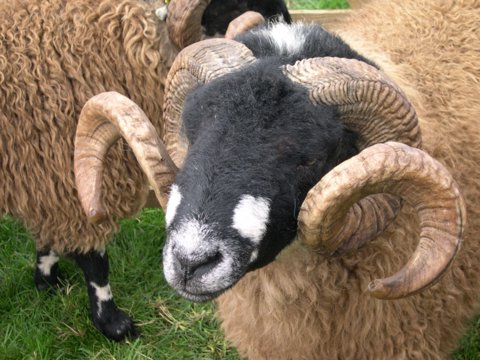
Unknown sheep breed - photo by NicePics from London, UK (Sheep with interesting horns) [CC-BY-SA-2.0 (www.creativecommons.org/licenses/by-sa/2.0)], via Wikimedia Commons
You can read more about sheep horns, advantages, disadvantages, what they are made of, and horn genetics, click here.
You can read more, and see other pictures, of the Jacob Sheep, click here.
Labels:
advantages,
breeds,
disadvantages,
ewes,
goats,
horns,
jacob,
non polled,
polled,
ram,
sheep
Subscribe to:
Posts (Atom)