Showing posts with label Katahdin. Show all posts

Friday, January 10, 2014

Katahdin Hair Sheep Ram Cross

Rams, male sheep, are sexually mature at five months of age.  They are not physically mature for another six to twelve months, as some sheep breeds grow faster than others.

Katahdins are relatively slow growing sheep, the rams mature slowly in terms of their physical size and appearance.  By the time they are a year they are pretty impressive, but at the age of two they can be quite stunning.  I remember at one auction a 4 year old Katahdin ram entered the ring and people gasped as so few had seen anything like it, he looked like a miniature cow, wide nose, strong appearance, and he was brown too. 

6 month old Katadhin cross ram. 


This (photo above) is a young Katahdin cross ram, he is not purebred, his mother is a Barbado hair sheep cross.   Hair sheep have many advantages and they are becoming more and more popular in the United States and Canada, where wool is generally not as valuable as it was even 20 years ago.  The photo gives you a good idea of how hair sheep look in the winter - as he does have a thicker coat.  He is only 6 months old in this picture and will get a longer mane as he gets older.

You can see his tail is a bit shorter than the natural tail of a wool sheep breed. Hair sheep do have shorter tails, and they are less likely to become dirty with feces.


Hair sheep do not need their tails docked, do not need to be sheared, are more parasite resistant and there are claims that their meat tastes superior, even in older animals.  I personally do not eat lamb or mutton, this is just what I have heard and read.

I try not to treat the rams as "pets" as I find if they are too friendly they can also become dangerous.   I like my ewes to be tame and friendly, but if a ram is a little bit scared of me that is okay!

Sunday, April 14, 2013

Katahdin Hair Sheep

Meet the Katahdin sheep, one of a few hair sheep breeds. They do not grow a fleece that would need shearing, and instead shed the thicker winter coat every spring.

Origins of Katahdin Sheep


Michael Piel, of Maine, USA, set about creating a breed of sheep to use for land maintenance, to control vegetation growth around power lines. In 1957 he imported three young African Hair Sheep, all of whom had been triplets but were not related to each other. Two were ewes, and one was a ram. From there he set about breeding them with each other and other select breeds including the Suffolk, Hampshire, and Cheviot.

He selected the sheep he kept for breeding based on "hair", fertility, meat type conformation, and flocking instinct. In the 1970's he named the new breed "Katahdin", after Mt. Katahdin, in Maine.

Michael passed away in 1976 and the breed went through some small changes, included an experiment in non-polled (horned) crosses, which was done away with in favor of polled (hornless) sheep.

A registry was established in 1986, under the name Katahdin Hair Sheep International.

Katahdin Ewe minutes after lambing, her back is good but the photo makes it look bad


Traits of Katahdin Sheep


The most obvious trait is that Katahdin sheep are covered with hair rather than wool, although some woolly hairs will still be present. This means they do not require shearing or their tails to be docked. The hair is somewhat coarse like that of a German Shepherd dog, and sheds in much the same way.

They are good mothers, often having triplets, although singles or twins are preferred for their first time lambing. Katahdin ewes are good milk producers, and seldom require assistance lambing (unless bred to larger breeds).

They are not a very aggressive sheep, and tend to flock moderately well.

An average Katahdin sheep ewe will weigh around 120 to 160 pounds, with the rams at 180 to 240 pounds. As such they are considered to be a "medium" size sheep.

Katahdin sheep have good parasite resistance.

The most common color being solid white, but Katahdins can also be brown or black, and occasionally are spotted.

Katahdin Ram, 1 year old


Uses of Katahdin Sheep


Katahdin sheep are terrific for hobby farmers looking for a low maintenance animal to control grass growth in their pastures. They will eat many weeds that other animals will over look.

Because they are docile and unusual looking, they also work well in petting zoos.

They are used in cross breeding programs to improve carcass condition, or for their mothering abilities.  Twins are common.

Typically though, most lambs are raised for meat. They have a top quality carcass that is mild in flavor and marketable even past the "lamb" stage. The meat is also particularly lean.

Other Information


With wool prices falling, the cost of shearing often is more than a person can market wool for, as such this breed, is gaining popularity.

Katahdin sheep are now in Canada (I have some), USA, Mexico, Chile, the UK, and Central America.

Wednesday, March 6, 2013

Four New Lambs in Two Days

Yesterday, March 5, 2013, I was home and expecting that one of our sheep would have her lambs soon.  I was on the computer helping a worried girl whose dog was showing signs of going into labor.  At one point I told her I knew what she was going through because I was waiting for a ewe to lamb.

Two Lambs

Not long after that, around my lunch time, I went out to check and sure enough there she was in the shed with two new lambs.  I went out to get her and bring her into the barn.  The weather was just around freezing and there was a breeze, no place for wet lambs to be outside.  I got them in and dried them off.

The mom is a Katahdin sheep, her sister was the ewe that gave birth only two days earlier.  I moved the sister and her lambs into a larger stall and put this new mom into the small stall.  Of course I got some new lamb pictures too!

Sadly she did have a third lamb, I found it dead in the stall later that afternoon even though I had been checking regularly.


New Lambs!

Then today, March 6, I went into the barn in the morning to find another ewe had lambed.  I was a bit surprised, we knew she was pregnant, but I still thought she had a few more days to go.  I moved the other mom into the large stall with her sister to open up the small stall for the new mother, Dark Brown Barbado, and her two lambs, one girl, one boy.

This is the ewe lamb. As you can see, she is still a bit wet, I dried them off more.


This is the sleepy ram lamb.


Well now we have just one ewe left to lamb, that being Patsy the part Jacob ewe with 4 horns.  I think she will be another few days, but she might surprise us too.  Today is a bit chilly so I do hope it warms up for all the ewes and their new baby lambs.


Join WebAnswers and get paid using Google Adsense, to ask and answer questions, as I was doing the day I found the first lambs.  Click here.

Monday, March 4, 2013

Cute Lambs Born in March

We have had mild weather for several weeks so we have been keeping our sheep (and lambs that were born in October) were outside all of the time, but on this particular day (March 3, 2013) it was a blizzard, with some wind gusts and 6 inches (15 cm), so decided to move the sheep into the barn for the night.

We knew that four ewes were expecting lambs.  We had bought a ram in October, ewes are pregnant for 5 months.  We did not think he had bred the ewes right away, but apparently he had.

As I was bringing in the sheep I noted one ewe was missing. If you have sheep it is very important not to assume all are there because it is sometimes easy to miss one, and a ewe that is thinking about lambing will separate herself from the others so might not come when called.

I went looking for the missing ewe, Mrs Brown Katahdin, a Katahdin (her breed) hair sheep. I found her standing in the old shed. She stomped her foot to try to keep me away, but I had no choice, she could not lamb out there in the cold. She was clearly in the process of delivering, her placenta was already out. I got her into the barn and left her.

After about an hour my husband and I went out to the barn to check her.  Sure enough there she was in a back corner with two little, and damp, lambs.  We had to hustle to get them into a private stall away from the other sheep.  We set her up in the stall with hay and water, and made sure the lambs were dry.  I took a few quick pictures, and sexed the lambs (both ewes) and left them alone for the night.

Cute Lamb Pictures!

Above is one of the ewe lambs, she is still a bit damp and you can even see the umbilical cord hanging down.  She is probably only an hour old (at most) in this photo.

Below is her sister, although these pictures were the following day, with this lamb being about 22 hours old or so.
She is perky and alert but still a bit wobbly on her feet.  The ewe and lambs will stay in the stall another day, they we will let them run around the whole barn, but it is much too snowy for them to go outside right now.

I will let you know when the other three ewes have their lambs.


911HealthShop.com


Tuesday, October 9, 2012

It is Fall, Time to Get a Ram

Normally rams are only put with ewes for breeding and as we do not have enough space to keep rams separate from the ewes we do not keep them and instead buy one in the fall and sell him in the spring (or sooner if we have a buyer).

We had a bit of a problem this year, first we bought a truck to pull the trailer but when we went to hook it up we found that the connector for the trailer lights was different. When we got to the auction we found it had been canceled (the owner of the auction market was in hospital). 

So we phoned the guy we have gotten rams from in the past, and he said he had a nice one for us, but did warn us the ram was young, and small. We prefer rams with a bit of color or unusual markings and he did say this ram was well marked, being black and white. He is a Katahdin – Dorper cross. For those of you not familiar with these breeds, they are hair sheep, and will not grow a proper coat of wool but they do get thicker coats for winter.  

At one time we quite enjoyed having rams with horns, the horns made good handles, but we found sometimes the lambs would get their heads stuck in the fences because of the horns so now we prefer the polled rams - those without horns.

He brought the ram over in the evening and it was already dark so I called the other sheep over so he wouldn't be alone roaming the pasture and calling for friends. It was a cloudy night so the animals did not even have the moon to see each other. With my flashlight I could make out the donkey, llama, and sheep, as they greeted each other. Assured that the new ram would not go crashing through fences in the dark, I went to bed.

The next morning I was happy to see they had all bonded well. Last years ram took a few days to fit in.
Already this guy has made a pal, as he was hanging close to one of the Katahdins. Later I noticed that Mrs Dark Brown Barbado was hanging around with those two and almost in a motherly way seemed to be watching over him. I assume the Katahdin ewe is in heat and that is why he is with her.


An interesting note is that it looks like 3 of our ewes are already pregnant, we figure this must have happened back in May or June, just before we sold the ram. Sheep are pregnant for 5 months, so I expect anytime soon we will have new lambs. 

So it looks like it might be a busy winter, with some lambs born soon, and some born in March. I will keep you posted!

Monday, March 12, 2012

Last Night Twins, Today Sleepy Lambs

Last night when we went to bring the sheep into the barn one ewe was missing.  We only had 2 ewes left to lamb but the missing one, whom we call White Katahdin (although she is really a light brown) was not big at all so it was a but of a surprise when my husband found her next to the barn with two lambs.

We got the lambs into the barn, one was larger, black and white, and the smaller one was orange and white.  I guessed the bigger lamb was male, and yup... that is what is was, the smaller one being a girl.  Momma followed close behind.

I did not want to walk to the house to get the camera, so we left them for the night and took pictures in the morning.  Here are the two lambs.


What I found most interesting is that their mother was particularly friendly with me.  She normally is quite nervous, and most mothers are especially nervous, but she was really good.

I kept them inside today, along with Favorite sheep who had her twins earlier yesterday, and put all the other moms and lambs out to play in the sun.  We still have snow on the ground but today was a bit cooler, temperatures hovering around zero. 


All the outside lambs seemed to have enjoyed running, jumping, and playing!  There are actually 10 lambs in this picture.

I am amazed that Dark Brown Barbado has not had her lambs yet, she is huge... perhaps tonight!

Wednesday, October 5, 2011

A Bright New Ram for Fall

After lambing in January and early February I had decided that this year I would plan smarter for lambs in later February or March.   As it happened there was a livestock Auction in the middle of September.  That ended up being a bit of a disaster.  We were planning on selling some chickens and ducks at the auction anyhow so got an early morning start, only to arrive at the Auction market and find out the auction was postponed until the following week. 

So once again we loaded our birds for the sale and looked forward to finding a ram for our small flock of ewes.  The problem was that not a single sheep was brought to that particular auction.  There were plenty of goats, pigs, and alpacas, but not one sheep.

We went home and looked on line at our favorite website for buying and selling livestock, but there were no rams for sale within a reasonable distance.   Panic was setting in.

Finally we found a guy, whom we had bought a ram from in the past, and as luck would have it he did have a ram for sale. 


Most people have larger farms and can keep a few rams, but with only 10 acres and no way of keeping them apart we do not keep a ram all year or we would risk him breeding ewes too soon and having lambs when we least want them!  As such we buy a ram in the fall, and sell him in the spring.

The ram we bought this year is a lovely black and white Dorper x Katahdin.  Not a purebred, but that is alright as our flock is mostly mixed ewes anyhow.  Our biggest concern was finding a ram, and we really wanted a hair sheep.

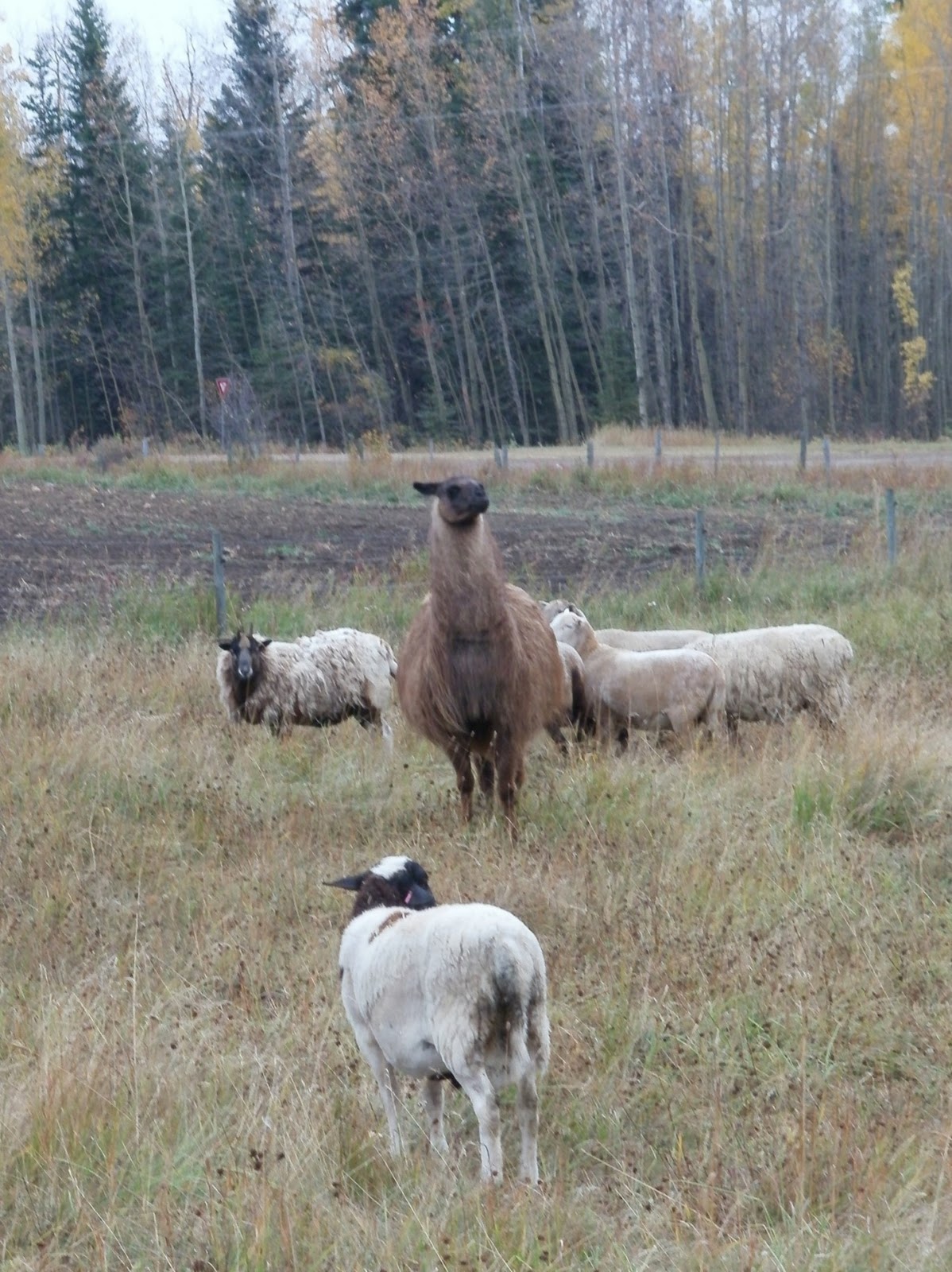
Our new ram was brought to us in the evening and it was already dark, by next day I went out to take pictures of him and watched as he tried to join the flock.  Crystal. the llama, was not about to hurt him, but I found this one picture perfect as the girls seemed to take shelter behind her.

Our new ram might just end up being called Oreo, for lack of any more original name, he is quite nice, and not as nervous around people as our last ram.  He is still young so will be big and handsome by spring when his lambs arrive.

Saturday, March 19, 2011

Baby Katahdin Scares, then has Lambs Days Later

Baby Katahdin, our youngest ewe - being born last year, and the only one who would be a first time mother, is a shy sheep.  She is a bit smaller and was terrified of us earlier in the year.  Throughout the winter she has slowly learned how to trust us (the oats helped) but is easily intimidated by the bigger sheep who push her out of the way at feeding time. 


She has been thin - so I have been hand feeding her extra oats.  Two nights ago, however, she started choking on her oats, to the point it looked like she was a gonner.. she was frothing at the mouth and stood frozen, clearly in fear.  I gave her a hard smack on  her shoulder hoping to clear her throat.  Well the poor sheep must have thought I was horrible, but after a few tense moments she was fine.


Today, March 19, 2011, I went outside to give the sheep some hay for lunch, this is because our weather has been crazy this winter and we still have over a foot of snow on the ground and it gives them something to do in the middle of these winter days – eat. Finally we are seeing temperatures around the freezing mark, or just above – today was +1C (just above melting).

At the time I could see Girlie was in the shed with her two young lambs (just over a week old) and with her was Baby Katahdin – and just above the snow drift I could see a tiny white head pop up so I knew she had a lamb.

I went into the house to call my daughter for help. It's never easy getting one sheep and her lambs into the barn in the middle of the day. We spotted a darker lamb laying near by – shivering – both were still wet, born only minutes earlier. It took some doing but we finally got them into the barn (and chased the other sheep back out).

My daughter dried off the lambs, while I got their mother some water - ewes often need a good drink after lambing and this one was no exception. 

Having twins for their first year is not easy, she seems to be mothering both though and hopefully will have enough milk to provide for them - as she has been thin and does not have a huge udder - this is a concern!


The white lamb is a male - ram lamb.  The brown one is a female - ewe lamb. 

So that brings our total to 18 lambs - 9 male, 9 female, a perfect split!

Friday, March 11, 2011

Girlies Matched Set of Twins

Girlie is part hair part wool sheep. Her mother is Mrs Dark Brown Barbado, the sheep who earlier had triplets, her father being a wool sheep x Barbado. Girlie had two lambs last year (her first lambs) but was a bit overwhelmed and we ended up bottle feeding one.

On March 10, Girlie did not come into the barn with the rest of the sheep. It was just lucky we noticed her missing really, as it was a cold night and we were hurrying. I went out and they Girlie was in the old barn, standing with two identical twins... well not quite identical, one is a ewe lamb, the other a ram lamb.

Both lambs are solid orange - their father being a Katahdin.  The little lambs needed to have their ears rubbed as they were quite cold – temperatures are still below freezing – well below seasonal normals.  The ram lamb is on the left, the ewe lamb on the right.


I took a few pictures after getting the mother ewe and her lambs set up in a stall but the camera seemed to be acting weird so gave my husband instructions to take more pictures in the morning after I went to work.

By morning time it would appear the camera was acting even weirder. My husband got several pictures, but most had terrible double images. Well that's what you get for buying a cheap Walmart Camera I guess.  The above photo is the only picture (of about 10) that did not have a double image, but the color is slightly odd.  I am pretty sure this is the ewe lamb. 

So far it looks like Girlie is letting both lambs nurse - so that is a good sign.  I hardly feel like looking after any more bottle baby sheep!

Sunday, January 23, 2011

One Lamb for Mrs Brown Katahdin

Mrs Brown Katahdin was found in the morning tucked into the big stall she had one lamb at her side.  We had left the stall door open since there were so many sheep now, and all were able to go out in the day. 

Temperatures were finally above freezing, it had been a nice night, and with the exception of the fact that the door had blown open allowing those who wanted to, free access to the hay outside, all was well. 

Mrs Brown Katahdin is a full sister to White Katahdin who had her lambs aready. 

Anyhow... Mrs Brown is very protective of her lamb, a ewe lamb, she stomps her foot just like her mom did, trying to scare me off.  I have shut them into the stall for the day.  Her lamb is big since it is the only one she had, and although the lamb was playing earlier, she was resting when I returned with the camera.

Ain't she cute?

You can Read more about Katahdin Sheep, click here.

Saturday, January 8, 2011

A whole lot more Lambs, Cute ones!

Just last night, January 7, 2011, when we went out to bring in the sheep for the night there were a few more sheep.. little ones.. lambs.   Dark Brown Barbado - named so because when we got her we had another Barbado ewe who was slightly lighter brown in color, had triplets!

There was one larger lamb, a white ram lamb, who looks like he will get horns, and two tiny ewe lambs.  We will have to watch closely to make sure all get enough to eat.  They were all pretty confused at first, mom must have given birth right when the sheep were getting ready to come in for the night and they had been jostled around a bit. 
Picture taken the morning after their birth, you can see how much bigger the white lamb is, the smaller brown ones are ewe lambs, the one in the middle was still wet when we found her the night before, and had to be dried off.

What were those two thinking turning away from the camera?? How about some head shots?


When I went out the following morning to get these pictures, before getting the pictures, I saw that another ewe had lambed during the night.  So rather than putting this new one, and her twins, in with this delicate family of three, we put this family, known as Mrs White Katahdin's family, in with Blackie sheep and her two lambs.

One of Mrs White Katahdins lambs is a ewe lamb, one is a ram lamb.  I have forgotten which is which!

You may have noticed both these ewes, and their lambs do not like like "normal" sheep.  They are hair sheep, and will shed much like a dog. 

Read about Blackies Lambs born earlier - click here.
Read about the Advantages of Hair Sheep - click here.

Monday, December 6, 2010

Advantages of Hair Sheep

Our first sheep were hair sheep but eventually we decided that hair sheep are the way to go.  They get thicker winter coats, and even have some wool hairs in the winter, but they shed in the spring and summer.  This means less work, which is great, particularly in areas where wool is not worth shearing and selling.  I note here that even if wool has no monetary value the wool sheep should still be shorn or they suffer in the heat. 

Hair sheep do not need their tails docked because they are shorter and as their tails are not covered in wool, the feces do not stick to them.  Typically wool sheep have their tails docked because manure stuck in the tail attract flies.

Katahdin ram
Hair sheep breeds tend to be smaller than most of the popular wool breeds, which makes them better to work with on small farms, or for people who are not strong enough for larger animals.  Although some people consider some of the hair breeds to be more nervous I have not found this to be the case. 

There are also many claims that hair sheep experience fewer problems with internal parasites.  I will say that keds are much less of a problem with hair sheep.

We find having a hair sheep ram to be the best for our breeding program, which includes larger wool sheep ewes as well as some hair sheep ewes.   The hair sheep ram means smaller lambs at birth, which translates to fewer lambing problems for the ewe.  I would not suggest breeding a hair sheep ewe to a larger wool breed ram.  The hair x wool sheep have an odd sort of coat that sheds partially.


We live in Canada, and have cold weather in the winters.  They hair sheep grow thicker coats in the winter, but should have winter protection (we keep ours in an unheated barn at night in the winter).  This is not so much of an issue really as we lamb in the winter so all our ewes are in the barn at night regardless of breed.  As you would expect, they are very tolerant of hot weather.

I would especially encourage anyone who wants to have sheep as pets, for meat, or for pasture control to consider hair sheep.

We have owned Barbado hair sheep as pictured above, Dorper, and Katahdin, which I am sure you will read about it other blog posts here!