Showing posts with label how. Show all posts

Tuesday, March 19, 2013

Lambs Born on St Patricks Day

March 17 was St Patrick's Day and the day Patsy sheep finally had her lambs. Patsy is an unusual looking sheep, she is part Jacob, part Barbado, she use to have 5 horns but knocked one off leaving her with 4. She is part wool sheep, part hair, so she sheds – sort of.


Three other ewes had their lambs last week, when the weather was good, but a nasty storm had blown in a few days earlier, dumping new snow and sending temperatures well below freezing. At night the moms with lambs are in a stall in the barn, the other sheep are loose in the rest of the barn, and I would let them outside for the day, while leaving the moms and new lambs in the barn. 

I knew Pasty was due any day, but in the morning she was eager to go outside.  She ate her oats and then snuck away as I was putting hay out. I noticed her standing in a shed to the back of the pasture. Sheep are herd animals, they do not go off on their own except for when they are lambing. I had to bribe her (with oats) to get her back into the barn because at -15 celsius it was much too cold to have lambs in a three sided shed.


I left the mom to be alone for a while going out to check on her a few times. At about 11:00 her amniotic sack was out (you can see it in the picture). I left her alone again, going back at noon. At noon I walked into the barn, Patsy was standing near the back of the barn was having contractions, her head was held up and she was straining. Having seen ewes give birth before I noted she looked to be having a harder time of it, so I turned to latch the barn door shut behind myself so I could get a closer look, but in the moment it took to latch the door, by the time I turned around her lamb was out!

Patsy stood up, turned around, and started cleaning off her lamb right away. I waited at the far end of t the barn for a few minutes. Her location at the back of the barn was not great, there is a gap around the back door which let in a cold draft so I wanted to move her, and her wet lamb, to a drier stall. I picked up the lamb and carried him to the stall and Patsy followed. I gave him a quick drying but mostly left the rest up to Patsy and I went back to the house.
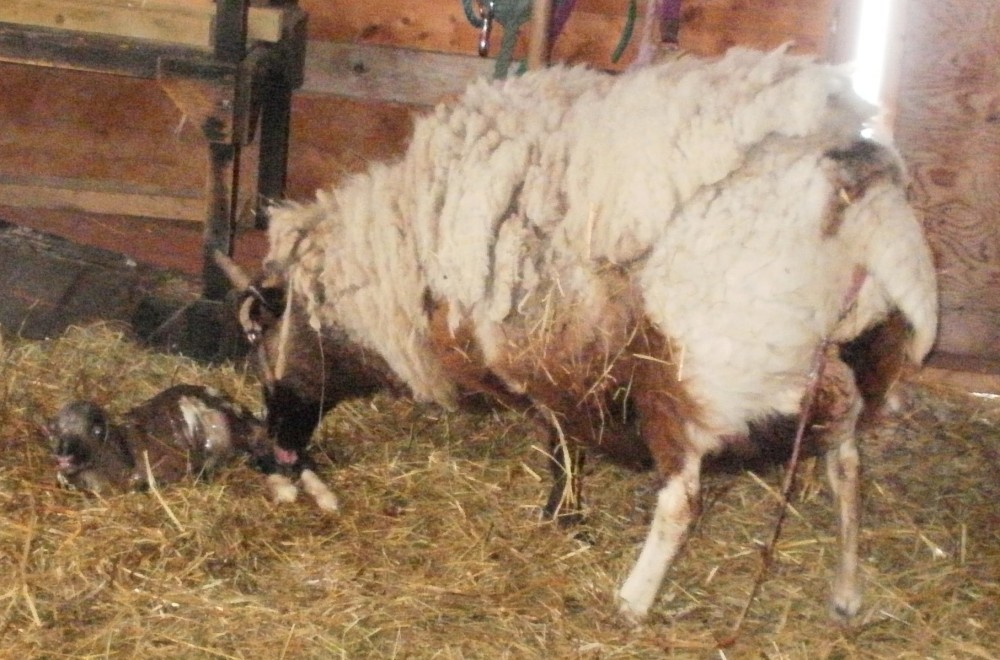


I returned an hour later (bringing water with me as we do not have running water in the barn) and as expected she had an other lamb with her. The second lamb was larger, and white. Although Patsy has had lambs before I think this was her first solid white lamb, most have been spotted like her.  The brown lamb does have white spots on his side.  Both lambs are male, ram lambs.


After another three hours her placenta was shed, I picked it up and took it to a place away from the barn area where I know ravens will come and gobble it up, and then added new dry straw to the stall. 

All sheep are doing well and hopefully the weather will improve.  

Click here to shop StateLineTack.com for Farm & Ranch Supplies!

Other Reading

My Husband's Account of the Lambing  - with some information on lambing in general

Monday, August 15, 2011

I do not Eat Sheep Meat

When I was young we lived in New Zealand for a  year; a country known for its sheep production.  Lamb was not exactly "cheap", but it was a common food in the area - and New Zealand lamb is exported world wide as a prime meat choice.

I never liked the taste of it, I always found it "gamey".  My mom, and everyone else in the family, loved it, and mom served it with mint sauce. Now, back in Canada, I keep sheep as pets, they mow the lawn, and I do not eat the meat.  To me it is no different than eating any other pet.

The term "lamb" is used to refer to the meat of any sheep under the age of one year old.  In some parts of the world the term "hogget" is used to denote the meat of an animal that is young, one year of age or so.  "Mutton" refers to the meat of a more mature animal, and is tougher. 

The age when the lamb is slaughtered can be broken down into more specific terms depending on the country it is slaughtered in.  Baby lamb comes from animals slaughtered between 6 and 8 weeks of age.  Most lamb is "Spring" lamb, coming from animals slaughtered between 3 and 5 months of age.


As I said I do not eat lamb.  I grew up in the city, and never learned the "mental" ability to kill my own meat.  I am a hypocrite in that I can raise lamb, but cannot even eat it, and having kept these animals (and chickens) as pets, I find myself becoming almost vegetarian!  Even so, I understand that some people do eat meat, and as such try to make sure my animals have good lives before they are sold. 

Sheep tend to be one of the luckier livestock animals in that for the most part (except for mulesing) in that they are not subjected to some of the cruel mass farming techniques that other livestock animals endure (such as feedlots). 

One thing we did notice is that the ethnic buyers prefer lambs that are left natural.  They do not want them wethered (castrated), they do not want their tails docked.  This is something producers should keep in mind if they wish to market their lambs to ethnic buyers (those from the middle east).

Lambs are usually slaughtered by being stunned and having their throats cut, being hung by one (or both) legs to allow the blood to drain.  Kosher slaughter is done when the animal is fully alert, meaning its throat is cut but it is not stunned first, they do not want the animals to know they are going to be killed, they do not want the animals to be afraid.

Sunday, February 13, 2011

The Elastrator Tool for Tail Docking and Lamb Castration

In sheep, both tail docking, and castration, are optional.  In some areas these are not done at all as they are seen as cruel, or unnatural.  Some meat buyers of certain cultures or religions prefer unblemished animals, meaning those that have not been altered in any way; they want full tails, and testicles, on the animals they raise, and/or buy.

We, at Kaleidscope Acres, do not dock our lambs tails, hair sheep not need this done, and we have never had problems with the wool sheep having natural tails either. 

The reasons for tail docking are so the fleece can be cut easier, and will be cleaner, as well there is less of a risk of fly strike.  Castrating sheep is done to make a ram into a wether, a sterile male sheep.

Tail docking, and castration, are often done to lambs, along with being vaccinated, around 3-5 days of age. 

In both cases there are a range of tools that can be used, one of which is the Elastrator, shown below.  The tool is opened to stretch out a small (special) rubber band.  Either the tail, or scrotum and testicles, are pulled through the elastic and it is released, pinching off the blood supply to that part of the body - which will fall off in a week or two. 


There are a few risks, one being tetanus, the other being if the rubber band is not placed correctly - if the tail is made too short the sheep could have problems (rectal prolapse being one).  If the testicles are not down into the scrotum they could be missed.

If asked about cruelty, I would have to say the proceedures are cruel, they may be necessary, but are still cruel.  The lambs do feel pain, if even for a short time.  Tail docking is not necessary in hair sheep, and even those which are hair sheep crosses, as the tails are often shorter than usual, and less wooly.  I would say that there are other methods of tail docking, and I do feel the elastrator is the least cruel method.

Related Sheep Links

Tail Docking in Sheep

What is a Wether?

Advantages of Hair Sheep

Fly Strike