Tuesday, March 19, 2013

Lambs Born on St Patricks Day

March 17 was St Patrick's Day and the day Patsy sheep finally had her lambs. Patsy is an unusual looking sheep, she is part Jacob, part Barbado, she use to have 5 horns but knocked one off leaving her with 4. She is part wool sheep, part hair, so she sheds – sort of.


Three other ewes had their lambs last week, when the weather was good, but a nasty storm had blown in a few days earlier, dumping new snow and sending temperatures well below freezing. At night the moms with lambs are in a stall in the barn, the other sheep are loose in the rest of the barn, and I would let them outside for the day, while leaving the moms and new lambs in the barn. 

I knew Pasty was due any day, but in the morning she was eager to go outside.  She ate her oats and then snuck away as I was putting hay out. I noticed her standing in a shed to the back of the pasture. Sheep are herd animals, they do not go off on their own except for when they are lambing. I had to bribe her (with oats) to get her back into the barn because at -15 celsius it was much too cold to have lambs in a three sided shed.


I left the mom to be alone for a while going out to check on her a few times. At about 11:00 her amniotic sack was out (you can see it in the picture). I left her alone again, going back at noon. At noon I walked into the barn, Patsy was standing near the back of the barn was having contractions, her head was held up and she was straining. Having seen ewes give birth before I noted she looked to be having a harder time of it, so I turned to latch the barn door shut behind myself so I could get a closer look, but in the moment it took to latch the door, by the time I turned around her lamb was out!

Patsy stood up, turned around, and started cleaning off her lamb right away. I waited at the far end of t the barn for a few minutes. Her location at the back of the barn was not great, there is a gap around the back door which let in a cold draft so I wanted to move her, and her wet lamb, to a drier stall. I picked up the lamb and carried him to the stall and Patsy followed. I gave him a quick drying but mostly left the rest up to Patsy and I went back to the house.
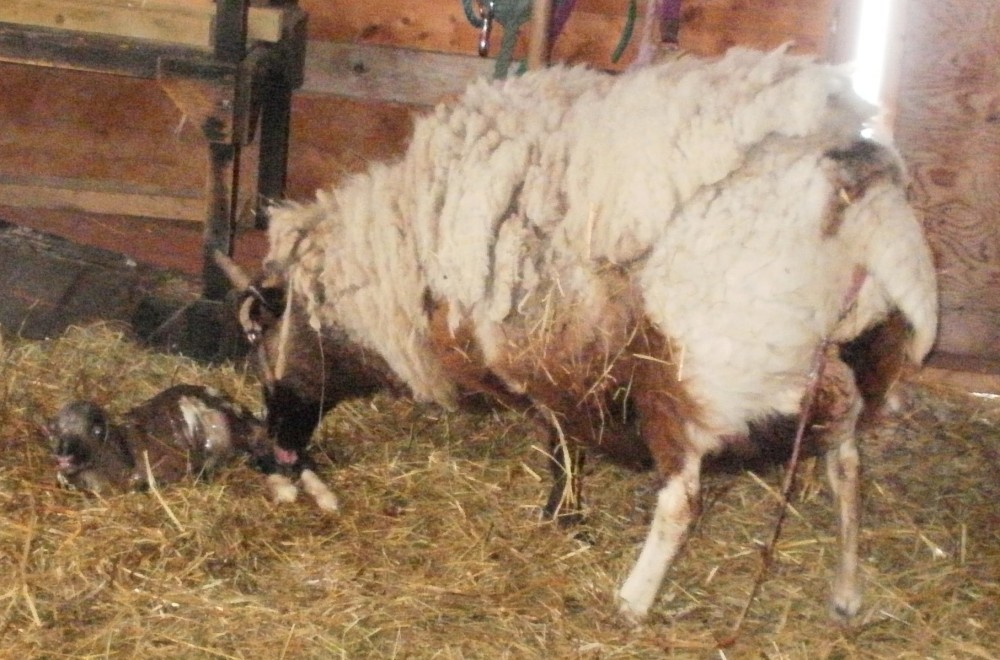


I returned an hour later (bringing water with me as we do not have running water in the barn) and as expected she had an other lamb with her. The second lamb was larger, and white. Although Patsy has had lambs before I think this was her first solid white lamb, most have been spotted like her.  The brown lamb does have white spots on his side.  Both lambs are male, ram lambs.


After another three hours her placenta was shed, I picked it up and took it to a place away from the barn area where I know ravens will come and gobble it up, and then added new dry straw to the stall. 

All sheep are doing well and hopefully the weather will improve.  

Click here to shop StateLineTack.com for Farm & Ranch Supplies!

Other Reading

My Husband's Account of the Lambing  - with some information on lambing in general

Wednesday, March 6, 2013

Four New Lambs in Two Days

Yesterday, March 5, 2013, I was home and expecting that one of our sheep would have her lambs soon.  I was on the computer helping a worried girl whose dog was showing signs of going into labor.  At one point I told her I knew what she was going through because I was waiting for a ewe to lamb.

Two Lambs

Not long after that, around my lunch time, I went out to check and sure enough there she was in the shed with two new lambs.  I went out to get her and bring her into the barn.  The weather was just around freezing and there was a breeze, no place for wet lambs to be outside.  I got them in and dried them off.

The mom is a Katahdin sheep, her sister was the ewe that gave birth only two days earlier.  I moved the sister and her lambs into a larger stall and put this new mom into the small stall.  Of course I got some new lamb pictures too!

Sadly she did have a third lamb, I found it dead in the stall later that afternoon even though I had been checking regularly.


New Lambs!

Then today, March 6, I went into the barn in the morning to find another ewe had lambed.  I was a bit surprised, we knew she was pregnant, but I still thought she had a few more days to go.  I moved the other mom into the large stall with her sister to open up the small stall for the new mother, Dark Brown Barbado, and her two lambs, one girl, one boy.

This is the ewe lamb. As you can see, she is still a bit wet, I dried them off more.


This is the sleepy ram lamb.


Well now we have just one ewe left to lamb, that being Patsy the part Jacob ewe with 4 horns.  I think she will be another few days, but she might surprise us too.  Today is a bit chilly so I do hope it warms up for all the ewes and their new baby lambs.


Join WebAnswers and get paid using Google Adsense, to ask and answer questions, as I was doing the day I found the first lambs.  Click here.

Monday, March 4, 2013

Cute Lambs Born in March

We have had mild weather for several weeks so we have been keeping our sheep (and lambs that were born in October) were outside all of the time, but on this particular day (March 3, 2013) it was a blizzard, with some wind gusts and 6 inches (15 cm), so decided to move the sheep into the barn for the night.

We knew that four ewes were expecting lambs.  We had bought a ram in October, ewes are pregnant for 5 months.  We did not think he had bred the ewes right away, but apparently he had.

As I was bringing in the sheep I noted one ewe was missing. If you have sheep it is very important not to assume all are there because it is sometimes easy to miss one, and a ewe that is thinking about lambing will separate herself from the others so might not come when called.

I went looking for the missing ewe, Mrs Brown Katahdin, a Katahdin (her breed) hair sheep. I found her standing in the old shed. She stomped her foot to try to keep me away, but I had no choice, she could not lamb out there in the cold. She was clearly in the process of delivering, her placenta was already out. I got her into the barn and left her.

After about an hour my husband and I went out to the barn to check her.  Sure enough there she was in a back corner with two little, and damp, lambs.  We had to hustle to get them into a private stall away from the other sheep.  We set her up in the stall with hay and water, and made sure the lambs were dry.  I took a few quick pictures, and sexed the lambs (both ewes) and left them alone for the night.

Cute Lamb Pictures!

Above is one of the ewe lambs, she is still a bit damp and you can even see the umbilical cord hanging down.  She is probably only an hour old (at most) in this photo.

Below is her sister, although these pictures were the following day, with this lamb being about 22 hours old or so.
She is perky and alert but still a bit wobbly on her feet.  The ewe and lambs will stay in the stall another day, they we will let them run around the whole barn, but it is much too snowy for them to go outside right now.

I will let you know when the other three ewes have their lambs.


911HealthShop.com


Sunday, January 13, 2013

About Cruelty to Livestock

One of the biggest debates in the food industry is around the cruelty to livestock. Vegans, vegetarians, and animal rights activists, often condemn the livestock industry as being cruel. Livestock keepers, and those involved with livestock, often deny any cruelty. In a case of one extreme to the other with neither one willing to bend it is hard to see sense of it all.

I feel it would be better if the livestock industry were honest that some cruelty does exist and that there may be room for improvement. It should also be noted that a lot of the cruelty is related to keeping costs low and this is in fact being pushed by the consumer.

It should also be noted that most of the incidences of cruelty are not simply the result of a farmer wanting to cause pain and suffering simply for the sake of causing pain and suffering to the animal. While this sort of thing does occur on occasion it is rarely by the farmer, or owner, of the livestock, and is more often done by employees.

Since I keep sheep I have taken a part of an article on cruelty to livestock and reposted it here with a link to the whole article below.


"Sheep are one of the few livestock animals not commonly kept in a factory type setting, they usually are kept on pasture had have a fairly ideal life, although often cut short for lambs headed to slaughter.
Their lives are not without some cruelty, the worst of which is mulesing. Mulesing is common in Australia and done to Merino sheep. The lambs are hung upside down by their feet and a dinner sized chunk of their rump is cut off without painkillers or antiseptics.

Docking of a lamb's tail is not particularly cruel, in fact because of the social uses of a dog's tail, docking a dog's tail can be considered more cruel than dockinga lamb's tail with the note that docking lamb's tails is done to keep flies away from the dirty tail. Flies can cause fly strike and can kill a lamb. Mulesing is done for the same reason but takes off the rump of the lamb.

Pregnant Karakul ewes are reported to be kicked to induce abortions or early labor. Others are slaughtered right before lambing so their fetal lamb can be harvested for its pelt."


For the record I am not a vegetarian and I am not against the meat industry as a whole, but I strongly dislike some of the “factory farm” methods of keeping other livestock, such as chickens, swine, and dairy cattle.

Cruelty can be reduced and one way of reducing it is to spread awareness to the consumer so they demand better treatment of farm animals and become more knowledgeable about where the meat they buy comes from.


Please use the comments area to share your opinions on cruelty in the livestock industry and how we can improve things.

Thursday, January 10, 2013

Great Way to Stay Safe when Riding Horses at Night

When you ride your horse in the evening you might think you are safe because you can see the headlights of oncoming vehicles. You might even wear a reflective vest, but it should be noted that a reflective vest is useless until vehicles are close too you, and at times drivers have been known to drive around at dusk without turning their headlights on at all. Reflective vests are not great on foggy days. 

The best way for you, as a rider, to be seen is to be lit up in some way. 

Carrying a flashlight is a good idea, but not always practical at all times. Instead if you are going to be riding in the evening you may want a light that can clip onto you, the saddle, or part of the bridle itself. These lights alert drivers more effectively than a reflective vest (which is still a good idea too) and are also good if your horse spooks and runs off in the dark, as it will be easier to see where your horse went. 

Nite Ize offers really cool products for dogs, light up toys, collars, and even lights you can put on the collar itself. These clip on lights are great for riders too as they can clip onto your saddle, reins, or bridle (but do not clip them too near to your horse's eyes).

Click on the image below to learn more and see other products...

These lights are ideal for people who go out for a ride in the evening because even if you start your ride when it is light it can get dark fast, or bad weather could change visibility, making you and your horse harder to see.

These lights are great for:
  • Riding in the Fog
  • Packing in the Mountains - as you might not reach your camp when you think you would
  • Riding in the Snow – in case the weather turns bad
  • Putting on your Dog's Collar – as when your dog tags along for your evening ride

Nite Ize has several different light up products that would work for any horse rider.

Tuesday, January 8, 2013

Mysterious Hair Loss on Lamb's Ears

I seldom blog about health worries, I once had a lamb blow up to the size of a balloon with bloat, I was too scared to take a picture thinking that if she died it would be too sad to look at the picture (yes I was not born a farmer and my sheep are more like pets than livestock)... That lamb did live and in fact is Blackie sheep whom you may have read about.

I have an odd health worry now, but not one that is too serious, it is mostly just puzzling. 

As you recall I had 7 lambs born in October. It is now January. A week or so ago I noticed two lambs (different moms) had some hair loss on their ears, just about where their ears attach to their heads. No other lambs had any such problems. The only thing the two lambs had in common was that they were white and black;  I also have 3 other lambs that are all black, one white and brown, and another black and white (unaffected at that point).
I thought.. hmm, maybe they need a new mineral block, so got that, but nothing seemed to change. I do not know if the lambs even lick it.

Well a couple of days ago the other black and white lamb also is showing some signs of hair loss on the ears, and he is also showing small areas of hair thinning on the sides of his nose.

The other 4 lambs are fine and show no hair missing.  There is no hair loss on the ewes either..  They are all wool sheep x hair sheep.

The areas of hair loss are too even and symmetrical to be anything such as ringworm or mange. 

I have found nothing online except one post that suggested an allergy to food combined with sunlight.
I should add that it is winter here, temperatures have been below freezing, we have snow and the sheep are getting hay and grain (oats). 

If anyone has any ideas I would love to hear them. My vet is not as familiar with sheep as he is with cattle and nobody else here has a clue. 


I have not been out with the camera (when it is cold the battery freezes too quick and I have just not thought about it), but I have used a picture of a different sheep and drawn in the places of hair loss.

Update - Below is a picture I took today, it's pretty hard to get a good picture of a goofy lamb with a crappy camera, but I gave it my best shot - note that the lamb's are not itching.  It actually seems like maybe the hair is growing back in, it's hard to tell.


Wednesday, December 12, 2012

What Dog Breeds are Best for Herding?

There are many dog breeds used for herding sheep, goats, cattle, and other livestock. Typically these dogs are very intelligent and do not always make ideal house pets because of their love of “work”.
Certain breeds of dogs used for herding are more popular in some areas than in others.

Border Collie


Border collies are one of the most popular herding dogs. They are highly intelligent and have a real desire to please. Movie fans will recognize this breed from the film “Babe” (the talking pig). 

They are sleek dogs with medium length hair. The most popular color for a border collie is black with white, however they can also be tri-colored or brown and white. They stand about knee high. Border collies always have an alert look in their eye, as though they are always looking for cues. If not used for herding, they enjoy agility.

Australian Cattle Dog


Also known as red heelers or blue heelers (according to their color), these dogs are tough and robust. Nipping at the heels of livestock is very much discouraged in other breeds of herding dog (such as the border collie), but the Australian Cattle dog was originally bred to nip at the heels of livestock as part of its herding behavior. Although this is not as common as it was, some dogs will still nip at running kids, or other pets.
These dogs did originate in Australia and were the product of herding dogs crossed with a few dingoes.


Welsh Corgi

photo from wikimedia commons


Welsh corgies are sometimes referred to as “The Queen's Dog” because of Queen Elizabeth's love of Pembroke Welsh corgis. The other type of Welsh corgi is the Cardigan Welsh corgi. The difference between the two is mainly that the Pembroke does not have a tail and is slightly smaller. Welsh corgis were bred to be short so they can avoid getting kicked by an angry cow or steer.

German Shepherd

©B Nelson - German Shepherd dog


Once a popular herding dog the German Shepherd is now more often used as a police, or personal protection dog. In fact most people no longer associate them with being herding dogs despite it being part of their name. 


Of course there are other collie breeds, the Shetland sheep dog, and many other dog breeds which are also popular for herding. Herding breeds should all be considered fairly intelligent and good for people who have lots of time to keep their dog mentally stimulated if not using it for herding.