Monday, June 13, 2011

Poor Rooster

Our poor new rooster, he lost his mate and his tail feathers all in the same day.  He was lucky to get away with his life, and fortunately roosters are not too fussy about their hens, and he can get a new one.  Read more of what happened the day a fox visited our farm.

hen in front, rooster in back

A few weeks ago we bought a few pet chickens from the bird auction. For the first time we got roosters. We put pairs of hens and roosters into our various bird enclosures. After a few weeks of getting them familiar to their new homes we would let one pair out in the day so they could be even more free range.

One pair was a Polish hen and rooster. Ideally they have feathers that shot out of their head like a crown or punk hair cut, our birds were just starting to grow these feathers in. They enjoyed being out and especially loved eating the dandelions. We have several pet cats, and they didn't bother the birds at all, so we had relatively no worries about letting them out in the day, at night they returned to their enclosures and we would shut the door.

the rooster days before the "attack"
We have never had fox problems on our hobby farm before. There was one time several years ago where a fox visited in the day, we played a bit of a game with it. I was trying to chase it away but it was on the other side of a large round plant bed, the fox would run around one way and switch directions every time I did rather than running off. Eventually he gave up and left and we never saw one since.

June 4th I let the pair out at 7:00 in the morning and at 9:30am and was just getting ready to go down stairs to clean the cat litter box. I have to walk by the front door, and when I did so I glanced out just in time to see a fox running by with a black chicken in its mouth!

I wasted no time in running out and going after it, still in my pajamas. I chased the fox down the driveway and was yelling. At a point the fox amazed me and did actually drop the bird. The panicking bird ran right past me heading for home while I chased the fox a few more steps. Then I turned to find the bird, but it was missing.

My husband came out (alerted by my yelling) and we both looked for the bird, and its mate. At this time we were not sure which chicken the fox had been holding in its mouth as even when I saw it running I was still focused on the fox. We found a big pile of feathers which were mostly long ones indicating that it had been the rooster, but the hen was also no where to be found.

I had to go to work, my husband continued to search the yard for the frightened, but fortunate, bird. It wasn't until 5:00 that day that the bird made its presence known, returning to its enclosure. It was the rooster. He looked angry and a bit scared, he hopped up on a roost where he felt safe. We still had no sign of a hen. It has been two days and she has not shown up (we were hoping she was hiding scared somewhere). It appears as though the fox must have gotten her first, and was returning for the rooster.

rooster back in his pen too scared to go on the ground
Foxes are known to be particularly smart, and good hunters. We never found any feathers indicating where it got the hen, so it must have got her without warning. A fox will often return to get as many birds as they can when they find an opportunity. We are lucky it only got one, but now our rooster is sad, lonely, and missing most of his tail.

rooster on the ground, missing his tail and hen

I have been keeping a look out for the returning fox, and so far he, or she, has not been back. 
We cannot blame the fox though, it was only doing what was natural, trying to get food to survive.
More Reading on Chickens


Monday, May 23, 2011

Seeing Eye Sheep and Seeing Eye Goats for a Blind Horse

Most people are well aware of seeing eye dogs, a dog that guides a blind person. A few people are aware of some seeing eye horses, these being horses that are trained to act as guides for a blind person.

You probably are not aware of seeing eye sheep and goats that act as guides for a blind horse. Apparently a quarter horse mare, named Sissy, has 10 companions who act as seeing eye animals. These consist of sheep and goats who act as guide animals for the 15 year old grey mare (horses can live into their early 20's, but are often sent to slaughter or euthanized in their teens).

The goats and sheep stand between Sissy and the fence to stop her from walking into it, they herd her (presumably with their vocalizations) towards hay, and water, allowing her to feed equally. They even direct her to shelter when it is needed. This all makes perfect sense when one understands that horses, goats, and sheep, are all herd animals. Having a large horse actually helps the smaller animals in coyotes are less likely to attack small animals when a larger (particularly taller) animal is with them.

Sissy and companion seeing eye Goat - photo from Reuters

Sissy and her farmyard pals are currently living in Deer Haven Ranch, a 300 acre rescue and retirement home for unwanted animals located in Montana.

Other Reading

Saturday, May 14, 2011

There's a Pig in the Yard

The other morning as my daughter was getting ready for school we noticed one of the cats looking keenly at something. I went to the window but couldn't see what it was so we figured it was just birds. Twenty minutes later and my daughter heads off to catch the school bus, but something is wrong, and I hear her calling me. I worry that something happened to one of the sheep, or perhaps there is a fox in the yard.

When I open the door to see what caused the commotion, my daughter calls to me “There is a Pig in the yard!”. I put on my boots and rush outside to see a male potbelly pig running up and down the fence line trying to get into the pasture with the sheep, who were well back from the fence.


The donkey, Aggie, and the llama, Crystal, were also standing well back, confused by this strange animal. I was a little disappointed that neither one of these “guard animals” was trying to chase the pig away.


My daughter said the pig has been running at the neighbors and they knew who owned it, so I called them. Apparently they had informed the owner, but the pig's owner had not come for it so they were very happy to keep it, as they have another pet pig too. So we proceeded to try to chase the boar (male pig) to the neighbor's home, about ¾ of a mile away.

All was going well until a car came down the road and the potbelly pig ran into the forest. I tried to find him but those things are fast and soon was too far into the forest to see or hear. Hopefully he found his own way out of the woods and back to the sow (female pig) at the other farm.

We have never kept pot bellied pigs, or any pigs in fact, as pets, but here is a link you can read to learn more about Pot Bellied Pigs as Pets.

Tuesday, May 10, 2011

Weaning Lambs

Weaning lambs can be difficult and stressful.  We just weaned our last lambs yesterday, and were kept awake most of the night by the ewes baaing.  If you own sheep and are approaching weaning time here are some tips to make it easier on you, the lambs, and the ewes.

The earliest you can wean lambs (the act of separating ewes and lambs) is 2 months old provided you give extra feed to the lambs and watch them closely.  Three months is preferred, and you should certainly wean the ram lambs before four months of age.  Ewes will wean the lambs on their own between three and five months of age, but ram lambs will be sexually mature at five months of age and may try to breed their mothers and other ewes.

The easiest way of lambing, is to sell (or remove) some lambs from the ewes that had multiples.  In other words, if a ewe had twins, or triplets, selling (or removing) one before the others is great.  This reduces the stress on her, in that she is not losing all lambs at the same time, and gives her some relief in that she is not feeding so many lambs.

When lambs are removed it is best if they are sold, or taken to where the ewe and lamb cannot hear each other, or they will try to reconnect and could get hurt running through fences.  If you cannot do this then you may need to put the lambs in the barn for a few days to allow the ewes to dry up.  They will be safer in the barn than running around crashing through fences.

If you have ram lambs with horns those should ideally be the first as their horns will be painful on the ewe's udder.

You can imagine how glad the mother of this little guy was to have him weaned.  Pictured here at three months, this is a Jacob sheep, ram lamb.

When removing the last lambs be sure to watch the ewe's closely to make sure their udder dries up.  If you were feeding the ewes grain, this should be reduced one day prior to weaning to help the ewe dry up.

Further Reading

Why Farmers Take Baby Animals Away from their Mothers

How to Care for Bottle Fed Lambs

*This information would also apply to weaning goat kids.

Thursday, April 28, 2011

Broken Horns on Sheep

When sheep break their horns it can be serious.  They could bleed to death, or they could suffer from the result of infection, or flies.  As well tetanus can be a concern. 


When we had some Jabob ewe lambs, one seemed prone to always knocking one of her horns off, causing bleeding, and worry.  If a sheep breaks a small horn treating with Iodine, or any other product you have for bleeding and/or infection, is a good idea.  You can apply something to keep the flies away too but keep it out of the wound unless instructed otherwise as per your veterinarian (not all products can be used on sheep). Make sure to stop the bleeding.

If the sheep does go off its feed, and starts grinding its teeth - call a vet.  If the horn was large and was broken right off (say on a Jacob, or Barbado ram) call a veterinarian immediately!

We just had a ram lamb, with small horn buds, knock one of the tips of his horns off.  We were separating the lambs from the ewes and accidents like this are likely to happen with lambs trying to get back to their moms. 


We treated with iodine, and are letting the wound heal on its own otherwise - exposed to the air.  It is still too cold for flies here, so we are not worried about that.

This picture was taken about 4 hours after the injury happened, it was bright red when it happened, but who thinks of taking a picture then?  You can see how small the other horn is, only about 2 inches (5cm).  The injured horn may be sore for a few days, but this little ram lamb should be fine and will continue to grow a horn in spite of the setback.

Tuesday, April 19, 2011

Innisfail Odd and Unusual Animal and Bird Auction Sheep and Goat Day

Twice a year there is a great three day auction held at the Innisfail Auction Market in Innisfail, Alberta.  This auction market holds regular cattle sales, as well as horse sales, but is also host to the Odd and Unusual Animal and Bird Auction.

Every Easter and Thanksgiving weekend a three day livestock and farm equipment auction is held in Innisfail.

On the first day (Friday) of the sale Goats and Sheep are sold.  Typically the sale opens with the bottle babies being sold - both goat kids, and lambs.  Then goats are auctioned off, followed by sheep.  Very often a few bags of feed are sold and a few other items related to sheep, and/or goats. 

Later in the day antiques, and caged pets are sold, with birds (including house birds as well as poultry) selling Saturday, and larger mammals on Sunday (horses, donkeys, bison, llamas, cattle, and so forth).  Tack and other large animal equipment is usually sold at the start of the Sunday sale. 

The sale is very well run, the animals penned so that people can look prior to the auction and make note of which animals they wish to bid on.  The sheep and goats are generally NOT run into the ring in numerical order but rather by gender. 


The auction sees many breeds of goats and sheep.  Fainting goats tend to be very popular at this auction sale as are hair sheep.

If you plan on attending as a buyer it is good to arrive early to have a look at the penned goats and sheep, as well you will want to get a good seat. 

If you plan on attending as a seller you will need to arrive extra early and get into line up to unload your animals.  Typically the animals well sell in the same order they arrived.  Birds must be in good boxes and you need to write a description on the box, it is best to do this at home prior to arriving.  Sheep require a CSIP tag.

If you are selling bottle baby goats, or bottle baby lambs, it is generally a good idea to bring a bottle and a days worth of formula powder to supply to the buyer of the animal.

For Innisfail Odd and Unusual Sale Dates and Contact Information - click here.

Thursday, April 7, 2011

Sheep Trivia and Facts

Just wanted to share some neat information on sheep, sheep trivia, as well as a few odd facts about sheep.

Not all breeds of sheep have wool, many have hair which they shed just like a dog.  They are called "Hair Sheep" and there are many breeds.  When crossed with wool sheep, the sheep often  have a mix of both (the part Jacob sheep pictured is also part hair sheep, you can see she is shedding).

Sheep do not have top teeth at the front of their mouth.

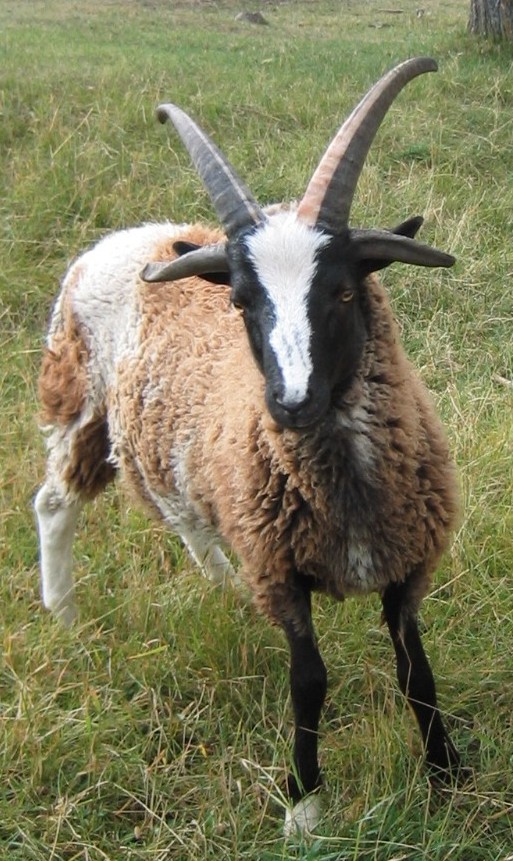
Some sheep have no horns, others have many, the sheep pictured below is a part Jacob sheep ewe, she actually has 5 horns although one is poorly developed.  Many sheep of this breed have four horns.
Sheep normally have long tails, these are often docked to prevent feces from building up on the tail. However there are also breeds of sheep who have fat tails, thicker than a persons arm.

Tennis rackets are often strung with “sheep gut” it takes the small intestines of eleven sheep to produce one racket.

Lanolin is an oil that protects the sheep's wool and keeps it water proof. It is also often used in products for human hair. Hair sheep do not have this lanolin.

Gestation (length of pregnancy) in sheep is 5 months. Most sheep will have one lamb their first year, and 1-3 lambs every year there after.  The process of giving birth is called "lambing".

Sheep are herd animals, they very much need to be kept with other sheep.

Although naturally nervous, sheep can be halter trained.

Sheep are natural grazers, but enjoy treats such as cut up apples, carrots, and beans.

Sheep cannot have copper in their diet, too much is toxic to them.

Lambs often jump will all four feet in the air at once, this is a playful jump known as “pronging”.

photo by scott liddell