Tuesday, November 29, 2011

Free Cats for Farmers

Farmers often have no problem getting “free” cats for their barn, but many do not bother to vaccinate their cats, or to spay or neuter them, as a result they often have more kittens than they need, or have sick cats.

On the other side of the coin there are always cats surrendered to animal shelters that are not suitable for adoption in most homes. Cats who are not using their litter box for behavioral reasons rather than treatable medical ones, are normally euthanized as “unadoptable” by most shelters.

Most of these cats would make suitable barn cats, or good shop cats, and as such many shelters are now trying to saves as many of these cats as they can by offering them up in such a way.

The Edmonton Humane Society is one place that has recently started a “Barn Buddies” program to give these cats a second chance. The cats are free (but donations are always welcome) and come vaccinated, chipped and spayed or neutered. They are also friendly. To note, some shelters do adopt out feral (less friendly) cats to farm homes as well. The Edmonton Humane Society requires interested people to apply with them for this program.

Potential adopters are required to have:

  • A barn or building where the cat can find shelter from bad weather.
  • Food for the cat. Note that a well fed cat is a better mouser.
  • The right attitude to make sure the cat is cared for and receives veterinary attention as needed.

If you are bringing home a new cat to the farm or shop, it should be kept in an enclosed space with food and water for several days to help it bond to the area.

If you are a farmer who could benefit from such a program please contact your local animal shelter to see if they have cats available under such a system.

The information for the Edmonton Humane Society's Barn Buddies program is here.

Tuesday, November 8, 2011

Snowy Morning and Bad Llama

A couple of days ago we woke up to snow, the first so far.  Normally, here in Alberta, we would have had more by now, but the fall has been wonderful.  Even the bit that we did get was not enough to shovel. 

The animals can still get grass but in the fall there is very little nutrition in the grass so we feed hay, just once a day for now, they will get fed twice a day later when we really start getting snow, and winter sets in. 

Naughty llama

We do have proper feeders near the barn for feeding hay, but have 2 bales near the house which we are feeding now.  One of the round bales was just a bit too close to the fence and Crystal decided to help herself.  As a result she has bent the fence.  I nailed a board across the top, but she leaned on it so bad it broke off.  Eventually the bale will be out of reach, but it's funny because even when there is plenty in the pasture she insists on eating from the bale.  I think it is because she has it all to herself that way. 

I always try to throw out several piles of hay because the animals tend to move around from pile to pile and push others away, by having extra piles it means everyone gets something to eat.

Patsy and Girlie having breakfast
As we only have 10 acres we do not grow our own hay, rather we buy it and have it delivered.  We do not even have a tractor to move bales around, so must feed by hand.  Certainly small square bales are easier to feed, but they cost more money, and are getting harder to find.  As such we buy the large round bales and have them delivered. 
We put tarps over the bales to protect them, sun can take away nutrition from hay, and if water gets into the bales they will rot!

When we buy the hay it is always hardest to know how much to buy.  In the past we have not bought enough and had to get some in the spring.  This was often because it kept snowing, and snowing, and snowing, so we kept feeding, and feeding, and feeding.  Hopefully this spring we will not have to worry about that and I will not need any more hay.

Wednesday, November 2, 2011

Pumpkins for the Sheep

A few years ago I carved a pumpkin and left it outside over night, when I woke up the next morning it was gone, only the burnt top remained.  I thought somebody stole it, but deer droppings made me realize that the deer had come by and eaten it up.

Sheep like pumpkins too, in fact most animals do.  After Halloween this year I had 3 pumpkins and no plans to make pie so I thought it would be nice to throw them over the fence for the sheep to eat.  I think the action of throwing these massive orange gourds over the fence scared the sheep for a few minutes, but it was not long before the more curious ewes approached.

Diamond sheep (pictured to the right) seemed  enjoy eating these large squash the most, with her sister, Favorite, and niece, Blackie sheep, also enjoying some pumpkin too, while most of the others stayed back.  Blackie (below) was quite comical as she even tried to roll the pumpkins around, pushing them with her forehead.

Pumpkins are loaded with nutritional benefits for pets and people.  They have beta carotene for eye health and are loaded with fiber to keep everyone regular.  The pumpkin seeds are said to help reduce the worm load in some animals, but are also noted for being particularly good to combat depression.

Giving pumpkins to the sheep to eat was also a way to break up the monotony of their day, even zoos often give some of their animals pumpkins at this time of the year, to play with and eat.

Many of our house pets can eat pumpkin too; birds, cats, and dogs, as well as rodents and reptiles.

If your pet has not had pumpkin before be sure to introduce this treat slowly.  As carnivores, cats won't eat too much pumpkin, but it is noted for helping control hairballs.  Rabbits will also enjoy pumpkin too.

If you used your pumpkins for jack-o-lanterns be sure to remove any candle wax and burnt areas from the inside of your pumpkin before you give them to your pets.

Crystal, our llama, usually charges ahead to investigate anything new but even she was concerned about these strange round objects.

Your pets will certainly enjoy this post-Halloween treat.  If you do not have pets, be sure to leave your pumpkins out for deer or birds, who may enjoy the different treat.


Monday, October 17, 2011

Always a Daughter, Also a Friend

People seem to think that livestock animals are without feelings to one and other.  By observing my own flock I clearly see this is untrue, not only do farm animals often form friendships with their own kind, they do tend to remember their offspring.  This contradicts what people are sometimes told, as I was often told as a child that farm animals do not remember their offspring after it is weaned, and particularly after they give birth the following year.

I do notice that even years later the sheep that were related tend to hang around each other more than with their non-relatives.  Mother's and daughters seem more close than sibling pairs. 

Dark Brown Barbado is a sheep we bought at auction, one we have had for a few years.  Early in 2009 she had twin lambs, Girlie being one of them.  Girlie is part wool sheep, she gets a woolly coat that sheds erratically and looks funny unless cut off. 

When the lambs were young I had told my daughter she could pick one to keep.  Her most favorite lambs happened to be rams, so she had to make another choice, and selected Dark Brown Barbado's lamb which she since named Girlie.  To make Girlie friendlier my daughter took her into a stall and gave her lambs starter pellet treats from her hand every day.   It was not long before Girlie learned to go to my daughter for regular treats. 


Girlie has had 2 sets of lambs herself, and has always remained friends with her mother.  This fall I took the picture of the two ewes standing in the pasture and thought they were posed quite nice, so wanted to share the photo here.

Girlie is in the back, with her mom, Dark Brown Barbado in the front. They are both starting to get their warmer winter coats.

Wednesday, October 5, 2011

A Bright New Ram for Fall

After lambing in January and early February I had decided that this year I would plan smarter for lambs in later February or March.   As it happened there was a livestock Auction in the middle of September.  That ended up being a bit of a disaster.  We were planning on selling some chickens and ducks at the auction anyhow so got an early morning start, only to arrive at the Auction market and find out the auction was postponed until the following week. 

So once again we loaded our birds for the sale and looked forward to finding a ram for our small flock of ewes.  The problem was that not a single sheep was brought to that particular auction.  There were plenty of goats, pigs, and alpacas, but not one sheep.

We went home and looked on line at our favorite website for buying and selling livestock, but there were no rams for sale within a reasonable distance.   Panic was setting in.

Finally we found a guy, whom we had bought a ram from in the past, and as luck would have it he did have a ram for sale. 


Most people have larger farms and can keep a few rams, but with only 10 acres and no way of keeping them apart we do not keep a ram all year or we would risk him breeding ewes too soon and having lambs when we least want them!  As such we buy a ram in the fall, and sell him in the spring.

The ram we bought this year is a lovely black and white Dorper x Katahdin.  Not a purebred, but that is alright as our flock is mostly mixed ewes anyhow.  Our biggest concern was finding a ram, and we really wanted a hair sheep.

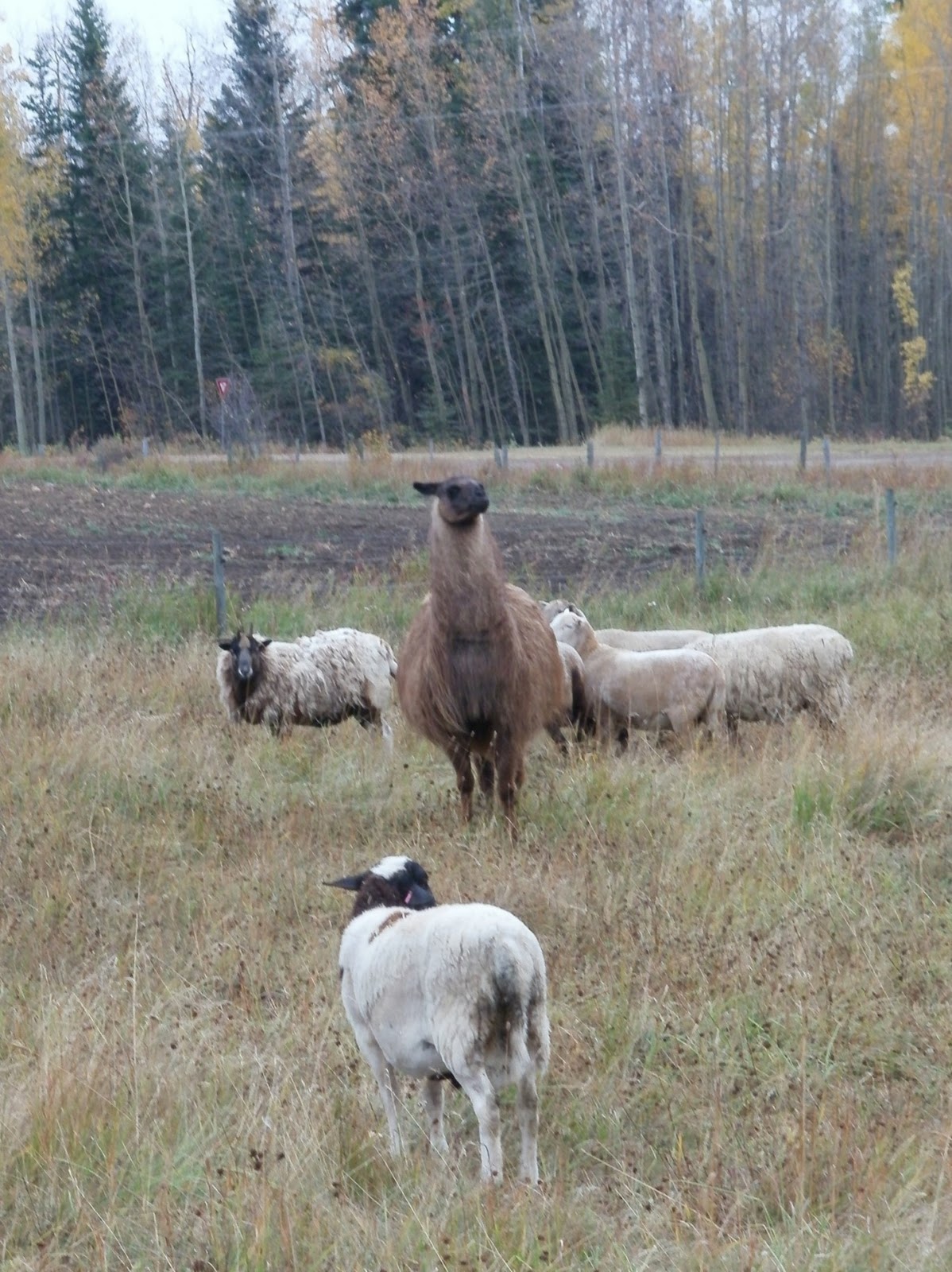
Our new ram was brought to us in the evening and it was already dark, by next day I went out to take pictures of him and watched as he tried to join the flock.  Crystal. the llama, was not about to hurt him, but I found this one picture perfect as the girls seemed to take shelter behind her.

Our new ram might just end up being called Oreo, for lack of any more original name, he is quite nice, and not as nervous around people as our last ram.  He is still young so will be big and handsome by spring when his lambs arrive.

Wednesday, September 21, 2011

The Auction that Wasn't

Every spring and fall in our area there are auctions for birds and sheep. We need a ram for the fall and want to get rid of some of the chickens and ducks as we do not have proper places to over winter those animals. I called the local auction market a month ago to find out when the sale was. I was informed it would be September 18. I need to know this because as we live in a tourist area we often work weekends and need to book time off to go to the auction.

The farm truck had not been started in over a year, that was another issue, We needed the truck to pull the trailer so we could bring home a ram. I really should not have waited until three days before the auction to try it out, but sure enough it was dead. After a lot of tinkering (and a jump start from a neighbor) we got it running, but when we turned it off it died. The price of a new battery would be more than a ram so we thought we would just go to the auction and see if anyone there could drive our new ram home.

The morning of the auction was cold, it had rained the night before and dropped below freezing for the first time this month. We got out at 8:30 in the morning to catch the birds and box them up, our hands were numb! But we got them all boxed up and the boxes just fit into our small car and off we went to the auction market.

One interesting thing did happen as we were boxing up the birds. The polish rooster screamed when he was caught and one of our cats came running, she started hissing like crazy. I don't know if she thought she was protecting us or him.


pic taken at an earlier auction


Something seemed a bit odd as we drove up, and as we got closer to the auction market it was clear. The auction had been postponed. There was a sign on the gate saying it would be next week, instead of this week. Apparently a fund raising (Terry Fox) marathon was taking place so they had to change dates. I am sure they published this in the newspaper, but we never saw anything ourselves.

I felt foolish driving home with all our birds.  The car stunk!

So... we will give it another go this Sunday, and will head to the Thorsby Auction market once again to sell our birds and buy a ram.

Monday, September 12, 2011

Selection of a Ram for Breeding Season

Fall time is when most people select the ram for their sheep production flock.  A sheep producer should be thinking about this well ahead of the time they require a ram. 

The first step in selecting a ram is to look at your ewes.  Do they have any genetic flaws that you need to avoid in your ram?  If so you need to keep this in the back of your mind when looking for your ram.  Consider what your desired lambs will look like and focus on finding a ram that will fill that gap. 

Are you breeding for meat or to produce more breeding animals?  If your goal is to produce mostly butcher lambs you need a ram that is bred for that purpose, but he does not need to be purebred, or registered.  If your goal is to produce more breeding animals, or those for show, and resale, you will want to spend more money and find a registered ram, ideally one who has proven himself at shows, or who has produced lambs who have done well.


The age of your the ram should be no younger than 5 months, by that time he will show you his potential, although he should not be put with too many ewes at this young age.  You probably will not want to buy a ram that is more than 5 years of age if you intend to keep him for many years as fertility will decline after this age.

Look at the overall condition of the ram.  Check his feet for signs of foot rot if it is known in your area.  Examine his teeth especially if you are intersted in keeping his lambs as future breeding stock.  It should also be said that a ram with small testicles should not be considered for breeding.  Ask to see his mother.  If she has lambed look at her udder;  you should not buy a ram from a ewe that has a poor udder if you want to keep ewe lambs from him for future breeding purposes.

Be sure to ask about general health of the flock and if he has been vaccinated or wormed.  Look at other sheep at the farm you are buying from, if you see any that are poorly looking, you may want to consider the overall health of the flock/farm as it relates to the prospect ram.  If the ram is thin he will need lots of extra feed to stay in top shape for breeding your ewes.

If your ewes are smaller do not over match the ram for them or they will have a difficult time giving birth and you may have several dead ewes and plenty of bottle baby lambs to look after.  Select a ram whose breed is comparable to your ewes, if they are first time lambers you may even want to select a ram that is a slightly smaller breed than the ewes.