Sunday, December 26, 2010

Sheep Horns

Depending on how familiar you are with sheep, you may have noticed that some sheep have horns and some do not. Horns on sheep are something that some keepers prefer, while others dislike.

Myself I prefer having horns on a ram, as they make for great handles, but like ewes without. That is to say I like a non-polled (has horns) ram, and polled (no horns) ewes. I do, however, have one ewe that has 5 horns, 3 well formed, and 2 smaller (scurred).


Patsy, one of our sheep, part Jacob, part Barbado.

People who breed purebred sheep might select for, or against, horns as a result of the breed standard and their own preference.   Some sheep breeds do not have horns on rams or ewes, others have horns on both genders, while others have horns only on the rams.  Owners of sheep breeds that can be either polled, or non polled, often select one or the other, but those keepers who have a preference need to select a breed that fits with their desires to have horns or not.

Goats often have their horn buds removed early in life because their horns tend to grow straight up, while sheep horns are often curled, and as such are less dangerous.  This is true of most sheep breeds, but not all, the Jacob sheep often have several horns (four is common) and these can be curled or straight.
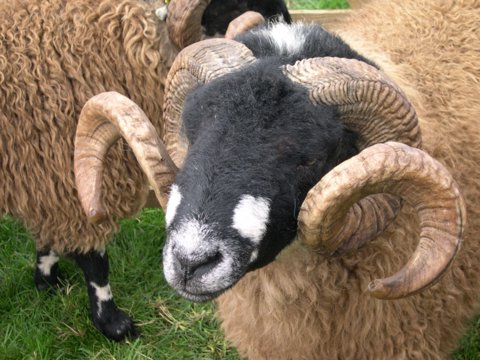
Unknown sheep breed - photo by NicePics from London, UK (Sheep with interesting horns) [CC-BY-SA-2.0 (www.creativecommons.org/licenses/by-sa/2.0)], via Wikimedia Commons

You can read more about sheep horns, advantages, disadvantages, what they are made of, and horn genetics, click here.

You can read more, and see other pictures, of the Jacob Sheep, click here.

Thursday, December 23, 2010

Meet Favorite Sheep

When we first got our sheep we thought it would be a good idea not to give them names, after all these were livestock animals, that might be sold.  As such our sheep ended up with non-name names, mostly color descriptions, because after all, we still needed some way of referencing which sheep was which and did not use ear tags. 

Soon one ewe got the name "Favorite" simply because she was the friendliest sheep and my daughter referred to her as her favorite sheep.

Here she is at one year of age, after her first shearing.

Favorite sheep became rather tame and would eat from your hand, but one day something went slightly wrong for Favorite sheep.

This was 2008, sheep were living with a donkey, llama, and miniature horses, including a miniature stallion.  All seemed to be fine together, and even now we are not sure if she got kicked, or had a stroke.  The only thing we do know is that one day she was not holding her ear correctly.  This was the summer, we checked the sheep daily but otherwise left them alone for grazing, and as such the small flock often got flighty and avoided us, when in the winter they always would come around looking for oats and treats.  Favorite otherwise looked fine, so we did not call the veterinarian at that time.

As time passed it was clear something had happened (xrays would have been expensive and finding out what happened really would not make a difference), however her tongue would hang from her mouth and it appeared she really did not have feeling in that side of her face, in fact food often builds up in her cheek and she spits it out regularly.

Favorite is at the front of the sheep, obviously still the "leader" of the other sheep, fast on her feet, but you can see she has something wrong when you look at her ear, eye, and face. 

Now... I know most keepers would have culled her (sold her or shot her) but... we had already named her "Favorite" how could we do such a thing?

Saturday, December 18, 2010

The Sheep Station Sheep Zone

The Sheep Station is Helium's Sheep Zone (Helium being a site where writers compete to have the best articles). The Sheep Station is run by Helium user Julie Helms, however there are oodles of great sheep related articles by many authors making this site an excellent resource for anyone who is interested in getting involved with sheep, already involved which sheep, or simply cooking dinner.

Julie has done a superb job scouring Helium for the best pages on everything sheep. The nice thing about Helium is that the articles are rated by other members so you know you are reading something that is not just is a rewrite of a Wikipedia page, but offers insider knowledge on the subject, in this case all aspects of sheep.

In the Helium Sheep Zone, The Sheep Station, readers can find links on breed information, care of sheep, diseases, lamb recipes, and so much more. There are also great links to other livestock, and animal, zones.

Above, some of my own sheep, Jacob ewes on the left, a Katahdin in the middle, and some shy ones peaking fom behind (a Barbado and Scottish WhiteFace)

I strongly encourage anyone interested in sheep to visit Helium's Sheep Zone, The Sheep Station, click here.

Tuesday, December 14, 2010

The Pros and Cons of Pet Chickens on the Farm

When we moved to our little acreage one of the things we wanted to get were some hens for eggs. There was a large shed that we easily converted into a chicken coop and build a large run around that, which we could open so the birds could have a proper “free range” after getting use to the home base.

We purchased eight hens, and 5 week old silkie chicks. The chicks were kept in the house in a large guinea pig cage (guinea pig free of course!).
Pros

The pros of keeping chickens – obviously eggs. Our hens were older birds, between eight of them we got about four eggs a day. These eggs were more than we could eat, as we want to encourage people eating Free range eggs, we sold the excess for $1 a dozen (in stores they are about $3 a dozen).

We soon learned that free range eggs are healthier than store bought, so that was certainly another plus.
Chickens eat bugs, flies, slugs, grasshoppers, and even fleas and ticks. That year we had a Ked problem (a wingless pest that feds on sheep) and noticed the hens would eat the Keds off the sheep.

Chickens are very low cost pets, we had to pay for laying ration, and chicken scratch, a bag of oystershell, and grit, but still these costs were much lower than dog food and supplies.

Chickens are friendly and trainable. Although most people do not take the time to get to know their chickens, we did. We handled the young silkie chicks daily (as it turned out all but one were roosters, so we sold them all to owners who wanted such). The older gals learned the daily routine and learned by watching us where the strawberry patch was, and were smart enough to eat the strawberries when nobody was looking! They would even talk to us.

Chickens are relatively maintenance free. Since we had a large coop, and let the birds free range, there was pretty much no mess, we only needed to clean the hen house once a month, and made simple checks on them daily to be sure they had food and water, much less work than a dog that would need regular exercise, and proper cleaning up after.

Cons

We learned one disadvantage of having pet chickens.. but only one. After keeping pet chickens we found it very hard to eat chicken ever again. Even looking at them dead in the grocery store has been difficult. In fact it has lead to us almost becoming full vegetarians.

Read about the Cruelty of Mass Egg Production (Battery Farms), Click Here

Read about What Breeds of Chickens are Best as Pets, Click Here

Monday, December 6, 2010

Advantages of Hair Sheep

As mentioned earlier in this Blog, we decided that hair sheep are the way to go.  They get thicker coats, and even have some wool hairs, in the winter, but shed in the spring and summer.  This means less work, particularly in areas where wool is not worth shearing and selling.  Hair sheep do not need their tails docked so that also makes them better for small farms like ours. 

Hair sheep breeds tend to be smaller, again, better to work with on small farms, or for people who are not big, tough, or have a lot of equipment.  Although some people consider them more nervous I have not found this to be the case as when we offer oats all our sheep cluster around to get their share, and will even eat out of our hands.

There are also many claims that hair sheep experience fewer problems with parasites.

We find having a hair sheep ram to be the best, as this also means smaller lambs, so fewer lambing problems for the ewe.  I would not suggest breeding a hair sheep ewe to a larger wool breed ram.  The hair x wool sheep have an odd sort of coat that sheds partially.

I would especially encourage anyone who wants to have sheep for pasture control to consider hair sheep.
We have owned Barbado hair sheep as pictured above, and also Dorper and Katahdin, which I am sure you will read about it other blog posts here!

Read more about the Advantages of Hair Sheep click here.
Learn more about the Breeds of Hair Sheep, click here.